I have these sayings going through my head. You know like --
"Be careful what you wish for" - 'we need some cold days for the maple trees to run sap'
"too much of a good thing" - global warming means the cows get to graze in January
"Biological Systems are Cyclical" - very warm, now very cold
All these things. Pipes burst in dairy plant. Someone or somehow the door was open 1/2" on the night of January 5th. That was the big wind -22 degree day... Also took out a check vlave in teh vat. That took $204 to fix. Pipes another $34 in supplies and time.
I am just cold all of the time. The poor small ruminants in the pole shed are cold. 4 lambs so far. Only one ewe. No kids thank God! I am hoping that they will hold off until it is consistently 40-50 degrees out.
Cheese has been put on back burner again. Doing wonderful experiments. The Appenzellar is actually very nice. The Asiago needs to be lower in fat, but promising. The Wenslydale is not quite there. The Double Gloucester needs more salt and something... not quite balanced and too bland. Toasts like nothing else though. The Leicester is getting there. Better than fall, but needs another 4 or 5 batches and another 5 months...
Entering the Colwick in a cheese cake contest on March 31st. It is a lovesly rustic cheese. Lactic drained one. Goes best with a glaze of bluberries and cultured cream.
Yoghurt/Labneh experiments going VERY well. Need to see what is up with the new TA 060 cultures. I am not the only one having problems with it. Elmond said a batch of moz. was crap after using that culture. My Cacciocavallo took for evvvver to get going and then dropped acid like a rocket. It was during a rainy period and Dave did start feeding the haylege in teh silo. It just seemed interesting that Elmond has a similar experience with it...
Thursday, March 08, 2007

Tuesday, January 02, 2007
Happy New Year
Almost said Happy New York... I'm posting while listening to Fords funeral on radio. Unger is here to look at some animals. Not worth starting the bull calves we found. Got $50 for a 8 week jersey cross and $200 for a 450# holstein bull calf. Well, not unless we sell them in plastic packaging anyways.
I just did some research on catching up on registrations of Ayrshire, Kerry and Arapawa animals. Did the To Do list for the New Year. Getting the house organized for the first time since we moved here.
I meet with a bee guy tomorrow to trouble shoot the beeswax issues I have. He gave me some good ideas. We'll wax cheese tomorrow. Tomme and Appenzellar, which will be interesting to see what turns out. Nutty cheese with mead character. Maybe called Backlava??
The order report stuff is on-line now. I'm going to see how that works out today. Promised to get them in on a timely basis for now on. My bad. Seems a shame to send in a report and pay $.46 for one month and a couple of dollars for the next. Planning on making a bit of cheese this year, so that will change.
Artisan cheese listserve was ended abruptly. Hope it wasn't because people told the moderator that she was sarcastic to a newbie. Seemed more agressive a post than she normally does. I hope things are ok with her. I was enjoying the conversations about the swiss style cheeses. I wouldn't worry so much about the eye development as I would the flavor. Flavor is what gets the price. Eyes are free to the customer. Besides, I prefer Guyere and Beufort types of Apline cheeses and they don;t have the ementaller type eyes.
Siobhan calved. Got her to milk with machines without kicking too bad. She is not going to be the most friendly cow in the earth, but by the time Patti gets her, she will be a good little dairy cow! Bull calf. We will name him Kieran. After St. Keiran (and St Piran for Cornwall). Vigorous little guy.
I hope all who read have a wonderful and prosperous New Year!
I just did some research on catching up on registrations of Ayrshire, Kerry and Arapawa animals. Did the To Do list for the New Year. Getting the house organized for the first time since we moved here.
I meet with a bee guy tomorrow to trouble shoot the beeswax issues I have. He gave me some good ideas. We'll wax cheese tomorrow. Tomme and Appenzellar, which will be interesting to see what turns out. Nutty cheese with mead character. Maybe called Backlava??
The order report stuff is on-line now. I'm going to see how that works out today. Promised to get them in on a timely basis for now on. My bad. Seems a shame to send in a report and pay $.46 for one month and a couple of dollars for the next. Planning on making a bit of cheese this year, so that will change.
Artisan cheese listserve was ended abruptly. Hope it wasn't because people told the moderator that she was sarcastic to a newbie. Seemed more agressive a post than she normally does. I hope things are ok with her. I was enjoying the conversations about the swiss style cheeses. I wouldn't worry so much about the eye development as I would the flavor. Flavor is what gets the price. Eyes are free to the customer. Besides, I prefer Guyere and Beufort types of Apline cheeses and they don;t have the ementaller type eyes.
Siobhan calved. Got her to milk with machines without kicking too bad. She is not going to be the most friendly cow in the earth, but by the time Patti gets her, she will be a good little dairy cow! Bull calf. We will name him Kieran. After St. Keiran (and St Piran for Cornwall). Vigorous little guy.
I hope all who read have a wonderful and prosperous New Year!
Friday, December 15, 2006
aging bit starting to happen
I don't have the trust fund or the huge financial backing, so I will not be building the cave. Too bad really. Great way to reduce my utility expenses. I did get the single door reach-in cooler the other day. A simple one that will go into the plant to brine/dry cheeses. That should do a lot towards my elimination of rind yuck that I battle with on a daily basis.
I hope to have things together enough to complete the whole Phase III part of my plan by March 2007. I am working in that direction. With the wet weather we were set back financially with the need to purchase the bale wrapper. I'm just getting things around enough to push this to the next step.
My goal is 10,000# of cheese in 2007. Do or die (hopefully quick and with a smile) I will do it. I also need to push for the 100 gal. vat. We have little milk over the winter. I need to calculate how much I need to process to cash flow the winter. I've already lined up the "other" products to sell in the farm stand. There is Arapawa goat soap, High Mowing seeds, thorvin and north american kelp, sea salt, redmond salt, thinking about cheese making stuff... Honey, beeswax products, milk, butter, eggs, I have the coffee maker...
The double Glaucester turned out interesting. I am intersted in the final outcome. The Small Holders cheese experiment turned out pretty well. Very mild, but I think that it how it is suppose to be. Honey Gouda sold out just after Christmas to my suprise. I think I'll need 20 wheels a week at current sales to make it til New Years next year. Not bad for 12-18# wheels!
I hope to have things together enough to complete the whole Phase III part of my plan by March 2007. I am working in that direction. With the wet weather we were set back financially with the need to purchase the bale wrapper. I'm just getting things around enough to push this to the next step.
My goal is 10,000# of cheese in 2007. Do or die (hopefully quick and with a smile) I will do it. I also need to push for the 100 gal. vat. We have little milk over the winter. I need to calculate how much I need to process to cash flow the winter. I've already lined up the "other" products to sell in the farm stand. There is Arapawa goat soap, High Mowing seeds, thorvin and north american kelp, sea salt, redmond salt, thinking about cheese making stuff... Honey, beeswax products, milk, butter, eggs, I have the coffee maker...
The double Glaucester turned out interesting. I am intersted in the final outcome. The Small Holders cheese experiment turned out pretty well. Very mild, but I think that it how it is suppose to be. Honey Gouda sold out just after Christmas to my suprise. I think I'll need 20 wheels a week at current sales to make it til New Years next year. Not bad for 12-18# wheels!
Tuesday, December 12, 2006
Voting with your trolley
Food politics Voting with your trolley
Dec 7th 2006 From The Economist print edition
Can you really change the world just by buying certain foods?
HAS the supermarket trolley dethroned the ballot box? Voter turnout in most developed countries has fallen in recent decades, but sales of organic, Fairtrade and local food—each with its own political agenda—are growing fast. Such food allows shoppers to express their political opinions, from concern for the environment to support for poor farmers, every time they buy groceries. And shoppers are jumping at the opportunity, says Marion Nestle, a nutritionist at New York University and the author of “Food Politics” (2002) and “What to Eat” (2006). “What I hear as I talk to people is this phenomenal sense of despair about their inability to do anything about climate change, or the disparity between rich and poor,” she says. “But when they go into a grocery store they can do something—they can make decisions about what they are buying and send a very clear message.”
Those in the food-activism movement agree. “It definitely has a positive effect,” says Ian Bretman of Fairtrade Labelling Organisations (FLO) International, the Fairtrade umbrella group. Before the advent of ethical and organic labels, he notes, the usual way to express political views using food was to impose boycotts. But such labels make a political act out of consumption, rather than non-consumption—which is far more likely to produce results, he suggests. “That's how you build effective, constructive engagement with companies. If you try to do a boycott or slag them off as unfair or evil, you won't be able to get them round the table.”
Consumers have more power than they realise, says Chris Wille of the Rainforest Alliance, a conservation group. “They are at one end of the supply chain, farmers are at the other, and consumers really do have the power to send a message back all the way through that complicated supply chain,” he explains. “If the message is frequent, loud and consistent enough, then they can actually change practices, and we see that happening on the ground.”
The $30 billion organic-food industry “was created by consumers voting with their dollars,” says Michael Pollan, the author of “The Omnivore's Dilemma” (2006), another of this year's crop of books on food politics. Normally, he says, a sharp distinction is made between people's actions as citizens, in which they are expected to consider the well-being of society, and their actions as consumers, which are assumed to be selfish. Food choices appear to reconcile the two.
How green is your organic lettuce?
Yet even an apparently obvious claim—that organic food is better for the environment than the conventionally farmed kind—turns out to be controversial. There are many different definitions of the term “organic”, but it generally involves severe restrictions on the use of synthetic pesticides and fertilisers and a ban on genetically modified organisms. Peter Melchett of the Soil Association, Britain's leading organic lobby group, says that environmental concerns, rather than health benefits, are now cited by British consumers as their main justification for buying organic food. (There is no clear evidence that conventional food is harmful or that organic food is nutritionally superior.)
But not everyone agrees that organic farming is better for the environment. Perhaps the most eminent critic of organic farming is Norman Borlaug, the father of the “green revolution”, winner of the Nobel peace prize and an outspoken advocate of the use of synthetic fertilisers to increase crop yields. He claims the idea that organic farming is better for the environment is “ridiculous” because organic farming produces lower yields and therefore requires more land under cultivation to produce the same amount of food. Thanks to synthetic fertilisers, Mr Borlaug points out, global cereal production tripled between 1950 and 2000, but the amount of land used increased by only 10%. Using traditional techniques such as crop rotation, compost and manure to supply the soil with nitrogen and other minerals would have required a tripling of the area under cultivation. The more intensively you farm, Mr Borlaug contends, the more room you have left for rainforest.
What of the claim that organic farming is more energy-efficient? Lord Melchett points out for example that the artificial fertiliser used in conventional farming is made using natural gas, which is “completely unsustainable”. But Anthony Trewavas, a biochemist at the University of Edinburgh, counters that organic farming actually requires more energy per tonne of food produced, because yields are lower and weeds are kept at bay by ploughing. And Mr Pollan notes that only one-fifth of the energy associated with food production across the whole food chain is consumed on the farm: the rest goes on transport and processing.
The most environmentally benign form of agriculture appears to be “no till” farming, which involves little or no ploughing and relies on cover crops and carefully applied herbicides to control weeds. This makes it hard to combine with organic methods (though some researchers are trying). Too rigid an insistence on organic farming's somewhat arbitrary rules, then—copper, a heavy metal, can be used as an organic fungicide because it is traditional—can actually hinder the adoption of greener agricultural techniques. Alas, shoppers look in vain for “no till” labels on their food—at least so far.
Fair enough
What about Fairtrade? Its aim is to address “the injustice of low prices” by guaranteeing that producers receive a fair price “however unfair the conventional market is”, according to FLO International's website. In essence, it means paying producers an above-market “Fairtrade” price for their produce, provided they meet particular labour and production standards. In the case of coffee, for example, Fairtrade farmers receive a minimum of $1.26 per pound for their coffee, or $0.05 above the market price if it exceeds that floor. This premium is passed back to the producers to spend on development programmes. The market for Fairtrade products is much smaller than that for organic products, but is growing much faster: it increased by 37% to reach €1.1 billion ($1.4 billion) in 2005. Who could object to that?
The Guardian
It makes me feel so good
Economists, for a start. The standard economic argument against Fairtrade goes like this: the low price of commodities such as coffee is due to overproduction, and ought to be a signal to producers to switch to growing other crops. Paying a guaranteed Fairtrade premium—in effect, a subsidy—both prevents this signal from getting through and, by raising the average price paid for coffee, encourages more producers to enter the market. This then drives down the price of non-Fairtrade coffee even further, making non-Fairtrade farmers poorer. Fairtrade does not address the basic problem, argues Tim Harford, author of “The Undercover Economist” (2005), which is that too much coffee is being produced in the first place. Instead, it could even encourage more production.
Mr Bretman of FLO International disagrees. In practice, he says, farmers cannot afford to diversify out of coffee when the price falls. Fairtrade producers can use the premiums they receive to make the necessary investments to diversify into other crops. But surely the price guarantee actually reduces the incentive to diversify?
Another objection to Fairtrade is that certification is predicated on political assumptions about the best way to organise labour. In particular, for some commodities (including coffee) certification is available only to co-operatives of small producers, who are deemed to be most likely to give workers a fair deal when deciding how to spend the Fairtrade premium. Coffee plantations or large family firms cannot be certified. Mr Bretman says the rules vary from commodity to commodity, but are intended to ensure that the Fairtrade system helps those most in need. Yet limiting certification to co-ops means “missing out on helping the vast majority of farm workers, who work on plantations,” says Mr Wille of the Rainforest Alliance, which certifies producers of all kinds.
Guaranteeing a minimum price also means there is no incentive to improve quality, grumble coffee-drinkers, who find that the quality of Fairtrade brews varies widely. Again, the Rainforest Alliance does things differently. It does not guarantee a minimum price or offer a premium but provides training, advice and better access to credit. That consumers are often willing to pay more for a product with the RA logo on it is an added bonus, not the result of a formal subsidy scheme; such products must still fend for themselves in the marketplace. “We want farmers to have control of their own destinies, to learn to market their products in these competitive globalised markets, so they are not dependent on some NGO,” says Mr Wille.
But perhaps the most cogent objection to Fairtrade is that it is an inefficient way to get money to poor producers. Retailers add their own enormous mark-ups to Fairtrade products and mislead consumers into thinking that all of the premium they are paying is passed on. Mr Harford calculates that only 10% of the premium paid for Fairtrade coffee in a coffee bar trickles down to the producer. Fairtrade coffee, like the organic produce sold in supermarkets, is used by retailers as a means of identifying price-insensitive consumers who will pay more, he says.
As with organic food, the Fairtrade movement is under attack both from outsiders who think it is misguided and from insiders who think it has sold its soul. In particular, the launch by Nestlé, a food giant, of Partners' Blend, a Fairtrade coffee, has convinced activists that the Fairtrade movement is caving in to big business. Nestlé sells over 8,000 non-Fairtrade products and is accused of exploiting the Fairtrade brand to gain favourable publicity while continuing to do business as usual. Mr Bretman disagrees. “We felt it would not be responsible to turn down an opportunity to do something that would practically help hundreds or thousands of farmers,” he says. “You are winning the battle if you get corporate acceptance that these ideas are important.” He concedes that the Fairtrade movement's supporters are “a very broad church” which includes anti-globalisation and anti-corporate types. But they can simply avoid Nestlé's Fairtrade coffee and buy from smaller Fairtrade producers instead, he suggests.
Besides, this is how change usually comes about, notes Mr Pollan. The mainstream co-opts the fringe and shifts its position in the process; “but then you need people to stake out the fringe again.” That is what has happened with organic food in America, and is starting to happen with Fairtrade food too. “People are looking for the next frontier,” says Mr Pollan, and it already seems clear what that is: local food.
“Local is the new organic” has become the unofficial slogan of the local-food movement in the past couple of years. The rise of “Big Organic”, the large-scale production of organic food to meet growing demand, has produced a backlash and claims that the organic movement has sold its soul. Purists worry that the organic movement's original ideals have been forgotten as large companies that produce and sell organic food on an industrial scale have muscled in.
This partly explains why food bought from local producers either directly or at farmers' markets is growing in popularity, and why local-food advocates are now the keepers of the flame of the food-activism movement. Local food need not be organic, but buying direct from small farmers short-circuits industrial production and distribution systems in the same way that buying organic used to. As a result, local food appears to be immune to being industrialised or corporatised. Organic food used to offer people a way to make a “corporate protest”, says Mr Pollan, and now “local offers an alternative to that.”
Think globally, act locally?
Buying direct means producers get a fair price, with no middlemen adding big margins along the distribution chain. Nor has local food been shipped in from the other side of the country or the other side of the world, so the smaller number of “food miles” makes local food greener, too. Local food thus appeals in different ways to environmentalists, national farm lobbies and anti-corporate activists, as well as consumers who want to know more about where their food comes from.
Obviously it makes sense to choose a product that has been grown locally over an identical product shipped in from afar. But such direct comparisons are rare. And it turns out that the apparently straightforward approach of minimising the “food miles” associated with your weekly groceries does not, in fact, always result in the smallest possible environmental impact.
The term “food mile” is itself misleading, as a report published by DEFRA, Britain's environment and farming ministry, pointed out last year. A mile travelled by a large truck full of groceries is not the same as a mile travelled by a sport-utility vehicle carrying a bag of salad. Instead, says Paul Watkiss, one of the authors of the DEFRA report, it is more helpful to think about food-vehicle miles (ie, the number of miles travelled by vehicles carrying food) and food-tonne miles (which take the tonnage being carried into account).
The DEFRA report, which analysed the supply of food in Britain, contained several counterintuitive findings. It turns out to be better for the environment to truck in tomatoes from Spain during the winter, for example, than to grow them in heated greenhouses in Britain. And it transpires that half the food-vehicle miles associated with British food are travelled by cars driving to and from the shops. Each trip is short, but there are millions of them every day. Another surprising finding was that a shift towards a local food system, and away from a supermarket-based food system, with its central distribution depots, lean supply chains and big, full trucks, might actually increase the number of food-vehicle miles being travelled locally, because things would move around in a larger number of smaller, less efficiently packed vehicles.
Research carried out at Lincoln University in New Zealand found that producing dairy products, lamb, apples and onions in that country and shipping them to Britain used less energy overall than producing them in Britain. (Farming and processing in New Zealand is much less energy intensive.) And even if flying food in from the developing world produces more emissions, that needs to be weighed against the boost to trade and development.
There is a strand of protectionism and anti-globalisation in much local-food advocacy, says Gareth Edwards-Jones of the University of Wales. Local food lets farming lobbies campaign against imports under the guise of environmentalism. A common argument is that local food is fresher, but that is not always true: green beans, for example, are picked and flown to Britain from Kenya overnight, he says. People clearly want to think that they are making environmentally or socially optimal food choices, he says, but “we don't have enough evidence” to do so.
What should a shopper do? All food choices involve trade-offs. Even if organic farming does consume a little less energy and produce a little less pollution, that must be offset against lower yields and greater land use. Fairtrade food may help some poor farmers, but may also harm others; and even if local food reduces transport emissions, it also reduces potential for economic development. Buying all three types of food can be seen as an anti-corporate protest, yet big companies already sell organic and Fairtrade food, and local sourcing coupled with supermarkets' efficient logistics may yet prove to be the greenest way to move food around.
Food is central to the debates on the environment, development, trade and globalisation—but the potential for food choices to change the world should not be overestimated. The idea of saving the world by shopping is appealing; but tackling climate change, boosting development and reforming the global trade system will require difficult political choices. “We have to vote with our votes as well as our food dollars,” says Mr Pollan. Conventional political activity may not be as enjoyable as shopping, but it is far more likely to make a difference.
GOOD FOOD?
Dec 7th 2006
If you think you can make the planet better by clever shopping, think
again. You might make it worse
"You don't have to wait for government to move... the really fantastic
thing about Fairtrade is that you can go shopping!" So said a
representative of the Fairtrade movement in a British newspaper this
year. Similarly Marion Nestle, a nutritionist at New York University,
argues that "when you choose organics, you are voting for a planet with
fewer pesticides, richer soil and cleaner water supplies."
The idea that shopping is the new politics is certainly seductive.
Never mind the ballot box: vote with your supermarket trolley instead.
Elections occur relatively rarely, but you probably go shopping several
times a month, providing yourself with lots of opportunities to express
your opinions. If you are worried about the environment, you might buy
organic food; if you want to help poor farmers, you can do your bit by
buying Fairtrade products; or you can express a dislike of evil
multinational companies and rampant globalisation by buying only local
produce. And the best bit is that shopping, unlike voting, is fun; so
you can do good and enjoy yourself at the same time.
Sadly, it's not that easy. There are good reasons to doubt the claims
made about three of the most popular varieties of "ethical" food:
organic food, Fairtrade food and local food (see article[1]). People
who want to make the world a better place cannot do so by shifting
their shopping habits: transforming the planet requires duller
disciplines, like politics.
BUY ORGANIC, DESTROY THE RAINFOREST
Organic food, which is grown without man-made pesticides and
fertilisers, is generally assumed to be more environmentally friendly
than conventional intensive farming, which is heavily reliant on
chemical inputs. But it all depends what you mean by "environmentally
friendly". Farming is inherently bad for the environment: since humans
took it up around 11,000 years ago, the result has been deforestation
on a massive scale. But following the "green revolution" of the 1960s
greater use of chemical fertiliser has tripled grain yields with very
little increase in the area of land under cultivation. Organic methods,
which rely on crop rotation, manure and compost in place of fertiliser,
are far less intensive. So producing the world's current agricultural
output organically would require several times as much land as is
currently cultivated. There wouldn't be much room left for the
rainforest.
Fairtrade food is designed to raise poor farmers' incomes. It is sold
at a higher price than ordinary food, with a subsidy passed back to the
farmer. But prices of agricultural commodities are low because of
overproduction. By propping up the price, the Fairtrade system
encourages farmers to produce more of these commodities rather than
diversifying into other crops and so depresses prices--thus achieving,
for most farmers, exactly the opposite of what the initiative is
intended to do. And since only a small fraction of the mark-up on
Fairtrade foods actually goes to the farmer--most goes to the
retailer--the system gives rich consumers an inflated impression of
their largesse and makes alleviating poverty seem too easy.
Surely the case for local food, produced as close as possible to the
consumer in order to minimise "food miles" and, by extension, carbon
emissions, is clear? Surprisingly, it is not. A study of Britain's food
system found that nearly half of food-vehicle miles (ie, miles
travelled by vehicles carrying food) were driven by cars going to and
from the shops. Most people live closer to a supermarket than a
farmer's market, so more local food could mean more food-vehicle miles.
Moving food around in big, carefully packed lorries, as supermarkets
do, may in fact be the most efficient way to transport the stuff.
What's more, once the energy used in production as well as transport is
taken into account, local food may turn out to be even less green.
Producing lamb in New Zealand and shipping it to Britain uses less
energy than producing British lamb, because farming in New Zealand is
less energy-intensive. And the local-food movement's aims, of course,
contradict those of the Fairtrade movement, by discouraging
rich-country consumers from buying poor-country produce. But since the
local-food movement looks suspiciously like old-fashioned protectionism
masquerading as concern for the environment, helping poor countries is
presumably not the point.
APPETITE FOR CHANGE
The aims of much of the ethical-food movement--to protect the
environment, to encourage development and to redress the distortions in
global trade--are admirable. The problems lie in the means, not the
ends. No amount of Fairtrade coffee will eliminate poverty, and all the
organic asparagus in the world will not save the planet. Some of the
stuff sold under an ethical label may even leave the world in a worse
state and its poor farmers poorer than they otherwise would be.
So what should the ethically minded consumer do? Things that are less
fun than shopping, alas. Real change will require action by
governments, in the form of a global carbon tax; reform of the world
trade system; and the abolition of agricultural tariffs and subsidies,
notably Europe's monstrous common agricultural policy, which coddles
rich farmers and prices those in the poor world out of the European
market. Proper free trade would be by far the best way to help poor
farmers. Taxing carbon would price the cost of emissions into the price
of goods, and retailers would then have an incentive to source locally
if it saved energy. But these changes will come about only through
difficult, international, political deals that the world's governments
have so far failed to do.
The best thing about the spread of the ethical-food movement is that it
offers grounds for hope. It sends a signal that there is an enormous
appetite for change and widespread frustration that governments are not
doing enough to preserve the environment, reform world trade or
encourage development. Which suggests that, if politicians put these
options on the political menu, people might support them. The idea of
changing the world by voting with your trolley may be beguiling. But if
consumers really want to make a difference, it is at the ballot box
that they need to vote.
-----
[1] http://www.economist.com/displayStory.cfm?story_ID=8380592
Dec 7th 2006 From The Economist print edition
Can you really change the world just by buying certain foods?
HAS the supermarket trolley dethroned the ballot box? Voter turnout in most developed countries has fallen in recent decades, but sales of organic, Fairtrade and local food—each with its own political agenda—are growing fast. Such food allows shoppers to express their political opinions, from concern for the environment to support for poor farmers, every time they buy groceries. And shoppers are jumping at the opportunity, says Marion Nestle, a nutritionist at New York University and the author of “Food Politics” (2002) and “What to Eat” (2006). “What I hear as I talk to people is this phenomenal sense of despair about their inability to do anything about climate change, or the disparity between rich and poor,” she says. “But when they go into a grocery store they can do something—they can make decisions about what they are buying and send a very clear message.”
Those in the food-activism movement agree. “It definitely has a positive effect,” says Ian Bretman of Fairtrade Labelling Organisations (FLO) International, the Fairtrade umbrella group. Before the advent of ethical and organic labels, he notes, the usual way to express political views using food was to impose boycotts. But such labels make a political act out of consumption, rather than non-consumption—which is far more likely to produce results, he suggests. “That's how you build effective, constructive engagement with companies. If you try to do a boycott or slag them off as unfair or evil, you won't be able to get them round the table.”
Consumers have more power than they realise, says Chris Wille of the Rainforest Alliance, a conservation group. “They are at one end of the supply chain, farmers are at the other, and consumers really do have the power to send a message back all the way through that complicated supply chain,” he explains. “If the message is frequent, loud and consistent enough, then they can actually change practices, and we see that happening on the ground.”
The $30 billion organic-food industry “was created by consumers voting with their dollars,” says Michael Pollan, the author of “The Omnivore's Dilemma” (2006), another of this year's crop of books on food politics. Normally, he says, a sharp distinction is made between people's actions as citizens, in which they are expected to consider the well-being of society, and their actions as consumers, which are assumed to be selfish. Food choices appear to reconcile the two.
How green is your organic lettuce?
Yet even an apparently obvious claim—that organic food is better for the environment than the conventionally farmed kind—turns out to be controversial. There are many different definitions of the term “organic”, but it generally involves severe restrictions on the use of synthetic pesticides and fertilisers and a ban on genetically modified organisms. Peter Melchett of the Soil Association, Britain's leading organic lobby group, says that environmental concerns, rather than health benefits, are now cited by British consumers as their main justification for buying organic food. (There is no clear evidence that conventional food is harmful or that organic food is nutritionally superior.)
But not everyone agrees that organic farming is better for the environment. Perhaps the most eminent critic of organic farming is Norman Borlaug, the father of the “green revolution”, winner of the Nobel peace prize and an outspoken advocate of the use of synthetic fertilisers to increase crop yields. He claims the idea that organic farming is better for the environment is “ridiculous” because organic farming produces lower yields and therefore requires more land under cultivation to produce the same amount of food. Thanks to synthetic fertilisers, Mr Borlaug points out, global cereal production tripled between 1950 and 2000, but the amount of land used increased by only 10%. Using traditional techniques such as crop rotation, compost and manure to supply the soil with nitrogen and other minerals would have required a tripling of the area under cultivation. The more intensively you farm, Mr Borlaug contends, the more room you have left for rainforest.
What of the claim that organic farming is more energy-efficient? Lord Melchett points out for example that the artificial fertiliser used in conventional farming is made using natural gas, which is “completely unsustainable”. But Anthony Trewavas, a biochemist at the University of Edinburgh, counters that organic farming actually requires more energy per tonne of food produced, because yields are lower and weeds are kept at bay by ploughing. And Mr Pollan notes that only one-fifth of the energy associated with food production across the whole food chain is consumed on the farm: the rest goes on transport and processing.
The most environmentally benign form of agriculture appears to be “no till” farming, which involves little or no ploughing and relies on cover crops and carefully applied herbicides to control weeds. This makes it hard to combine with organic methods (though some researchers are trying). Too rigid an insistence on organic farming's somewhat arbitrary rules, then—copper, a heavy metal, can be used as an organic fungicide because it is traditional—can actually hinder the adoption of greener agricultural techniques. Alas, shoppers look in vain for “no till” labels on their food—at least so far.
Fair enough
What about Fairtrade? Its aim is to address “the injustice of low prices” by guaranteeing that producers receive a fair price “however unfair the conventional market is”, according to FLO International's website. In essence, it means paying producers an above-market “Fairtrade” price for their produce, provided they meet particular labour and production standards. In the case of coffee, for example, Fairtrade farmers receive a minimum of $1.26 per pound for their coffee, or $0.05 above the market price if it exceeds that floor. This premium is passed back to the producers to spend on development programmes. The market for Fairtrade products is much smaller than that for organic products, but is growing much faster: it increased by 37% to reach €1.1 billion ($1.4 billion) in 2005. Who could object to that?
The Guardian
It makes me feel so good
Economists, for a start. The standard economic argument against Fairtrade goes like this: the low price of commodities such as coffee is due to overproduction, and ought to be a signal to producers to switch to growing other crops. Paying a guaranteed Fairtrade premium—in effect, a subsidy—both prevents this signal from getting through and, by raising the average price paid for coffee, encourages more producers to enter the market. This then drives down the price of non-Fairtrade coffee even further, making non-Fairtrade farmers poorer. Fairtrade does not address the basic problem, argues Tim Harford, author of “The Undercover Economist” (2005), which is that too much coffee is being produced in the first place. Instead, it could even encourage more production.
Mr Bretman of FLO International disagrees. In practice, he says, farmers cannot afford to diversify out of coffee when the price falls. Fairtrade producers can use the premiums they receive to make the necessary investments to diversify into other crops. But surely the price guarantee actually reduces the incentive to diversify?
Another objection to Fairtrade is that certification is predicated on political assumptions about the best way to organise labour. In particular, for some commodities (including coffee) certification is available only to co-operatives of small producers, who are deemed to be most likely to give workers a fair deal when deciding how to spend the Fairtrade premium. Coffee plantations or large family firms cannot be certified. Mr Bretman says the rules vary from commodity to commodity, but are intended to ensure that the Fairtrade system helps those most in need. Yet limiting certification to co-ops means “missing out on helping the vast majority of farm workers, who work on plantations,” says Mr Wille of the Rainforest Alliance, which certifies producers of all kinds.
Guaranteeing a minimum price also means there is no incentive to improve quality, grumble coffee-drinkers, who find that the quality of Fairtrade brews varies widely. Again, the Rainforest Alliance does things differently. It does not guarantee a minimum price or offer a premium but provides training, advice and better access to credit. That consumers are often willing to pay more for a product with the RA logo on it is an added bonus, not the result of a formal subsidy scheme; such products must still fend for themselves in the marketplace. “We want farmers to have control of their own destinies, to learn to market their products in these competitive globalised markets, so they are not dependent on some NGO,” says Mr Wille.
But perhaps the most cogent objection to Fairtrade is that it is an inefficient way to get money to poor producers. Retailers add their own enormous mark-ups to Fairtrade products and mislead consumers into thinking that all of the premium they are paying is passed on. Mr Harford calculates that only 10% of the premium paid for Fairtrade coffee in a coffee bar trickles down to the producer. Fairtrade coffee, like the organic produce sold in supermarkets, is used by retailers as a means of identifying price-insensitive consumers who will pay more, he says.
As with organic food, the Fairtrade movement is under attack both from outsiders who think it is misguided and from insiders who think it has sold its soul. In particular, the launch by Nestlé, a food giant, of Partners' Blend, a Fairtrade coffee, has convinced activists that the Fairtrade movement is caving in to big business. Nestlé sells over 8,000 non-Fairtrade products and is accused of exploiting the Fairtrade brand to gain favourable publicity while continuing to do business as usual. Mr Bretman disagrees. “We felt it would not be responsible to turn down an opportunity to do something that would practically help hundreds or thousands of farmers,” he says. “You are winning the battle if you get corporate acceptance that these ideas are important.” He concedes that the Fairtrade movement's supporters are “a very broad church” which includes anti-globalisation and anti-corporate types. But they can simply avoid Nestlé's Fairtrade coffee and buy from smaller Fairtrade producers instead, he suggests.
Besides, this is how change usually comes about, notes Mr Pollan. The mainstream co-opts the fringe and shifts its position in the process; “but then you need people to stake out the fringe again.” That is what has happened with organic food in America, and is starting to happen with Fairtrade food too. “People are looking for the next frontier,” says Mr Pollan, and it already seems clear what that is: local food.
“Local is the new organic” has become the unofficial slogan of the local-food movement in the past couple of years. The rise of “Big Organic”, the large-scale production of organic food to meet growing demand, has produced a backlash and claims that the organic movement has sold its soul. Purists worry that the organic movement's original ideals have been forgotten as large companies that produce and sell organic food on an industrial scale have muscled in.
This partly explains why food bought from local producers either directly or at farmers' markets is growing in popularity, and why local-food advocates are now the keepers of the flame of the food-activism movement. Local food need not be organic, but buying direct from small farmers short-circuits industrial production and distribution systems in the same way that buying organic used to. As a result, local food appears to be immune to being industrialised or corporatised. Organic food used to offer people a way to make a “corporate protest”, says Mr Pollan, and now “local offers an alternative to that.”
Think globally, act locally?
Buying direct means producers get a fair price, with no middlemen adding big margins along the distribution chain. Nor has local food been shipped in from the other side of the country or the other side of the world, so the smaller number of “food miles” makes local food greener, too. Local food thus appeals in different ways to environmentalists, national farm lobbies and anti-corporate activists, as well as consumers who want to know more about where their food comes from.
Obviously it makes sense to choose a product that has been grown locally over an identical product shipped in from afar. But such direct comparisons are rare. And it turns out that the apparently straightforward approach of minimising the “food miles” associated with your weekly groceries does not, in fact, always result in the smallest possible environmental impact.
The term “food mile” is itself misleading, as a report published by DEFRA, Britain's environment and farming ministry, pointed out last year. A mile travelled by a large truck full of groceries is not the same as a mile travelled by a sport-utility vehicle carrying a bag of salad. Instead, says Paul Watkiss, one of the authors of the DEFRA report, it is more helpful to think about food-vehicle miles (ie, the number of miles travelled by vehicles carrying food) and food-tonne miles (which take the tonnage being carried into account).
The DEFRA report, which analysed the supply of food in Britain, contained several counterintuitive findings. It turns out to be better for the environment to truck in tomatoes from Spain during the winter, for example, than to grow them in heated greenhouses in Britain. And it transpires that half the food-vehicle miles associated with British food are travelled by cars driving to and from the shops. Each trip is short, but there are millions of them every day. Another surprising finding was that a shift towards a local food system, and away from a supermarket-based food system, with its central distribution depots, lean supply chains and big, full trucks, might actually increase the number of food-vehicle miles being travelled locally, because things would move around in a larger number of smaller, less efficiently packed vehicles.
Research carried out at Lincoln University in New Zealand found that producing dairy products, lamb, apples and onions in that country and shipping them to Britain used less energy overall than producing them in Britain. (Farming and processing in New Zealand is much less energy intensive.) And even if flying food in from the developing world produces more emissions, that needs to be weighed against the boost to trade and development.
There is a strand of protectionism and anti-globalisation in much local-food advocacy, says Gareth Edwards-Jones of the University of Wales. Local food lets farming lobbies campaign against imports under the guise of environmentalism. A common argument is that local food is fresher, but that is not always true: green beans, for example, are picked and flown to Britain from Kenya overnight, he says. People clearly want to think that they are making environmentally or socially optimal food choices, he says, but “we don't have enough evidence” to do so.
What should a shopper do? All food choices involve trade-offs. Even if organic farming does consume a little less energy and produce a little less pollution, that must be offset against lower yields and greater land use. Fairtrade food may help some poor farmers, but may also harm others; and even if local food reduces transport emissions, it also reduces potential for economic development. Buying all three types of food can be seen as an anti-corporate protest, yet big companies already sell organic and Fairtrade food, and local sourcing coupled with supermarkets' efficient logistics may yet prove to be the greenest way to move food around.
Food is central to the debates on the environment, development, trade and globalisation—but the potential for food choices to change the world should not be overestimated. The idea of saving the world by shopping is appealing; but tackling climate change, boosting development and reforming the global trade system will require difficult political choices. “We have to vote with our votes as well as our food dollars,” says Mr Pollan. Conventional political activity may not be as enjoyable as shopping, but it is far more likely to make a difference.
GOOD FOOD?
Dec 7th 2006
If you think you can make the planet better by clever shopping, think
again. You might make it worse
"You don't have to wait for government to move... the really fantastic
thing about Fairtrade is that you can go shopping!" So said a
representative of the Fairtrade movement in a British newspaper this
year. Similarly Marion Nestle, a nutritionist at New York University,
argues that "when you choose organics, you are voting for a planet with
fewer pesticides, richer soil and cleaner water supplies."
The idea that shopping is the new politics is certainly seductive.
Never mind the ballot box: vote with your supermarket trolley instead.
Elections occur relatively rarely, but you probably go shopping several
times a month, providing yourself with lots of opportunities to express
your opinions. If you are worried about the environment, you might buy
organic food; if you want to help poor farmers, you can do your bit by
buying Fairtrade products; or you can express a dislike of evil
multinational companies and rampant globalisation by buying only local
produce. And the best bit is that shopping, unlike voting, is fun; so
you can do good and enjoy yourself at the same time.
Sadly, it's not that easy. There are good reasons to doubt the claims
made about three of the most popular varieties of "ethical" food:
organic food, Fairtrade food and local food (see article[1]). People
who want to make the world a better place cannot do so by shifting
their shopping habits: transforming the planet requires duller
disciplines, like politics.
BUY ORGANIC, DESTROY THE RAINFOREST
Organic food, which is grown without man-made pesticides and
fertilisers, is generally assumed to be more environmentally friendly
than conventional intensive farming, which is heavily reliant on
chemical inputs. But it all depends what you mean by "environmentally
friendly". Farming is inherently bad for the environment: since humans
took it up around 11,000 years ago, the result has been deforestation
on a massive scale. But following the "green revolution" of the 1960s
greater use of chemical fertiliser has tripled grain yields with very
little increase in the area of land under cultivation. Organic methods,
which rely on crop rotation, manure and compost in place of fertiliser,
are far less intensive. So producing the world's current agricultural
output organically would require several times as much land as is
currently cultivated. There wouldn't be much room left for the
rainforest.
Fairtrade food is designed to raise poor farmers' incomes. It is sold
at a higher price than ordinary food, with a subsidy passed back to the
farmer. But prices of agricultural commodities are low because of
overproduction. By propping up the price, the Fairtrade system
encourages farmers to produce more of these commodities rather than
diversifying into other crops and so depresses prices--thus achieving,
for most farmers, exactly the opposite of what the initiative is
intended to do. And since only a small fraction of the mark-up on
Fairtrade foods actually goes to the farmer--most goes to the
retailer--the system gives rich consumers an inflated impression of
their largesse and makes alleviating poverty seem too easy.
Surely the case for local food, produced as close as possible to the
consumer in order to minimise "food miles" and, by extension, carbon
emissions, is clear? Surprisingly, it is not. A study of Britain's food
system found that nearly half of food-vehicle miles (ie, miles
travelled by vehicles carrying food) were driven by cars going to and
from the shops. Most people live closer to a supermarket than a
farmer's market, so more local food could mean more food-vehicle miles.
Moving food around in big, carefully packed lorries, as supermarkets
do, may in fact be the most efficient way to transport the stuff.
What's more, once the energy used in production as well as transport is
taken into account, local food may turn out to be even less green.
Producing lamb in New Zealand and shipping it to Britain uses less
energy than producing British lamb, because farming in New Zealand is
less energy-intensive. And the local-food movement's aims, of course,
contradict those of the Fairtrade movement, by discouraging
rich-country consumers from buying poor-country produce. But since the
local-food movement looks suspiciously like old-fashioned protectionism
masquerading as concern for the environment, helping poor countries is
presumably not the point.
APPETITE FOR CHANGE
The aims of much of the ethical-food movement--to protect the
environment, to encourage development and to redress the distortions in
global trade--are admirable. The problems lie in the means, not the
ends. No amount of Fairtrade coffee will eliminate poverty, and all the
organic asparagus in the world will not save the planet. Some of the
stuff sold under an ethical label may even leave the world in a worse
state and its poor farmers poorer than they otherwise would be.
So what should the ethically minded consumer do? Things that are less
fun than shopping, alas. Real change will require action by
governments, in the form of a global carbon tax; reform of the world
trade system; and the abolition of agricultural tariffs and subsidies,
notably Europe's monstrous common agricultural policy, which coddles
rich farmers and prices those in the poor world out of the European
market. Proper free trade would be by far the best way to help poor
farmers. Taxing carbon would price the cost of emissions into the price
of goods, and retailers would then have an incentive to source locally
if it saved energy. But these changes will come about only through
difficult, international, political deals that the world's governments
have so far failed to do.
The best thing about the spread of the ethical-food movement is that it
offers grounds for hope. It sends a signal that there is an enormous
appetite for change and widespread frustration that governments are not
doing enough to preserve the environment, reform world trade or
encourage development. Which suggests that, if politicians put these
options on the political menu, people might support them. The idea of
changing the world by voting with your trolley may be beguiling. But if
consumers really want to make a difference, it is at the ballot box
that they need to vote.
-----
[1] http://www.economist.com/displayStory.cfm?story_ID=8380592
Thursday, December 07, 2006
computer
I wish I knew html and all of those other computer alphabet soup letters. Then this blog would look great and I'd have my web site up and...
I hired a new guy to do the web site. If my computer will cooperate, I'll have the stuff to him by this weekend! Got CD thingy ready and it froze. Been doing that since. Worse comes to worse, I'll flood him with emails. That always seems to work lately (if I use the right email).
Head cold again. Death by Snots I think it is called. Makes me sound more masculine or just sick. Hard to be taken seriously when I have a cold. Trying not to make too many phone calls.
As we get closer to the whole organic grain part of our transition, Dave is panicking. UCF may drop orgo line, UCF on again by feed rep not making any calls, Called grain coop who deals with RIcher feeds, Richer Feeds on and off again, Cargill comes back into the line up. How about getting Coop to carry a PA line. Call Coop to give names of those guys. UCF may just be dropping NY, but sales guy coming tomorrow...
Trying to get cookies started, web site info (talked about already) stuff compiled. Clean out cheese cooler and rinds, finish cornell projects, think about processing schedule for 2007...
My mind is cluttered and I don't have the drive anymore. Must be the grey weather. Combine it with my own personal oofs and I feel like I'm getting nothing accomplished. Lake effect snow tonight. Only good thing is that I may not have to bring Claire to school tomorrow. Still have to consider market on Saturday and cheesemaking on Sunday and and and...
I hired a new guy to do the web site. If my computer will cooperate, I'll have the stuff to him by this weekend! Got CD thingy ready and it froze. Been doing that since. Worse comes to worse, I'll flood him with emails. That always seems to work lately (if I use the right email).
Head cold again. Death by Snots I think it is called. Makes me sound more masculine or just sick. Hard to be taken seriously when I have a cold. Trying not to make too many phone calls.
As we get closer to the whole organic grain part of our transition, Dave is panicking. UCF may drop orgo line, UCF on again by feed rep not making any calls, Called grain coop who deals with RIcher feeds, Richer Feeds on and off again, Cargill comes back into the line up. How about getting Coop to carry a PA line. Call Coop to give names of those guys. UCF may just be dropping NY, but sales guy coming tomorrow...
Trying to get cookies started, web site info (talked about already) stuff compiled. Clean out cheese cooler and rinds, finish cornell projects, think about processing schedule for 2007...
My mind is cluttered and I don't have the drive anymore. Must be the grey weather. Combine it with my own personal oofs and I feel like I'm getting nothing accomplished. Lake effect snow tonight. Only good thing is that I may not have to bring Claire to school tomorrow. Still have to consider market on Saturday and cheesemaking on Sunday and and and...
Saturday, November 25, 2006
X-Mas rush
Otherwise known as avoid going to New Hartford at all costs! I hate crowds and stupid suburban drivers. Needed printer ink and Bookstore fix. Came away with anxiety and strong desire to shop for everything on-line. If only one can get a grocery delivery service in rural America. Wouldn't need to leave the farm.
Thinking about Distribution/Food Chain projects and the 100 mile diets. Could I survive the last one? Single, yes, but with a more traditional Yankee diet consuming husband and typical pre-K aged daughter? I think I will seriously research this in more depth. I like the 100-mile diet idea and I think Hank and I can come up with something dynamic/systainable in the Food-Chain/Distribution area...
That is my weekend project. Think about food systems. Get Grant projects completed for the new year. Get web site done... Things upon things upon things. Oh yah, and the pile of cordwood to get in before teh snows start next weekend.
Thinking about Distribution/Food Chain projects and the 100 mile diets. Could I survive the last one? Single, yes, but with a more traditional Yankee diet consuming husband and typical pre-K aged daughter? I think I will seriously research this in more depth. I like the 100-mile diet idea and I think Hank and I can come up with something dynamic/systainable in the Food-Chain/Distribution area...
That is my weekend project. Think about food systems. Get Grant projects completed for the new year. Get web site done... Things upon things upon things. Oh yah, and the pile of cordwood to get in before teh snows start next weekend.
Monday, November 13, 2006
Apathy
There is this difference between Collecting and Conserving rare breeds of cattle. I think that there is this grey area as well. Most feel that they are conserving the breed when they multiply numbers. That is the case to a degree. Not developing a whole herd or flock plan and just multiplying for the sake of multiplying is not the answer. Look at the Guernsey. It can devistate a herd pretty quickly. Especially when all breeders use the same bull families over and over again.
For critical breeds there is sometimes a reason that they are still a critical population. There seems to be this sort of apathy. A go it alone kind of mentality. They are friendly towards each other, but consiously choose not to work together. It is hard to fathom why they have the breed. Some it is for pure speculation. Others because it is so rare. Some for a true passion to save critical genetics. Others happen onto animals and for lack of anyother reason, just like the individual animal and don't seem to want to breed it. All valid reasons. All reasons why the animal is rare.
I am developing this desire to NOT organize anymore. To not try to develop plans and talk to people and make meeting plans... I have become one of the many tired worn out coordinators that are all over the sustainable agriculture movement that act as champions. WOrk tirelessly for many hours. Some succeed, others fail. People like me just grow weary of the fight without a co-champion to help...
For critical breeds there is sometimes a reason that they are still a critical population. There seems to be this sort of apathy. A go it alone kind of mentality. They are friendly towards each other, but consiously choose not to work together. It is hard to fathom why they have the breed. Some it is for pure speculation. Others because it is so rare. Some for a true passion to save critical genetics. Others happen onto animals and for lack of anyother reason, just like the individual animal and don't seem to want to breed it. All valid reasons. All reasons why the animal is rare.
I am developing this desire to NOT organize anymore. To not try to develop plans and talk to people and make meeting plans... I have become one of the many tired worn out coordinators that are all over the sustainable agriculture movement that act as champions. WOrk tirelessly for many hours. Some succeed, others fail. People like me just grow weary of the fight without a co-champion to help...
Friday, November 03, 2006
Road Trip
It was one of those days. Had to do the Road Trip. Lisa's daughter wasn't feeling well. We were hankering for bacon and she needed the lamb. Went to Taberg. Lake effect snow warnings didn't scare us...
Started to have pangs of regret that I gave up the pastured meat deal. I used Dave's "I've killed enough animals" excuse. Even to get out of working on projects that Krys and others asked me to look into. I think that part of me hates the whole dynamics of working with others, the other wants peace at home. Dave hated the hours I'd spend working on these projects. I do miss the cash flow from marketing grass-fed meat. Lamb in particular.
I need to get through the whole winter of nothing accomplished thing. Aging facility holding for what ever reason. Boy do I hate waiting for other people... Being dissapointed with the way things are working with guest cheesemakers. Wanting to have some control of my business. This go slowly waiting bull shit is driving me up a wall...
Bought paint at Home Depot. Close to Dave's appointment, so bought a gallon. Also a trim colour in a qt. size that Claire decided to throw when she was pissed that I didn't buy yet another thing that struk her fancy. Apparently Home Depot is prepared for spoiled 4 year olds that were given paint cans to throw.
I have to decide pretty quickly what EXACTLY I am going to do. That will be it. At this point I don't care what everyone else has for plans. I am just going to bull ahead and get the cheese/farm business into the black and hammer make something of this.
Started to have pangs of regret that I gave up the pastured meat deal. I used Dave's "I've killed enough animals" excuse. Even to get out of working on projects that Krys and others asked me to look into. I think that part of me hates the whole dynamics of working with others, the other wants peace at home. Dave hated the hours I'd spend working on these projects. I do miss the cash flow from marketing grass-fed meat. Lamb in particular.
I need to get through the whole winter of nothing accomplished thing. Aging facility holding for what ever reason. Boy do I hate waiting for other people... Being dissapointed with the way things are working with guest cheesemakers. Wanting to have some control of my business. This go slowly waiting bull shit is driving me up a wall...
Bought paint at Home Depot. Close to Dave's appointment, so bought a gallon. Also a trim colour in a qt. size that Claire decided to throw when she was pissed that I didn't buy yet another thing that struk her fancy. Apparently Home Depot is prepared for spoiled 4 year olds that were given paint cans to throw.
I have to decide pretty quickly what EXACTLY I am going to do. That will be it. At this point I don't care what everyone else has for plans. I am just going to bull ahead and get the cheese/farm business into the black and hammer make something of this.
Thursday, October 19, 2006
She cut her hair!!!!
Well, I guess it is another passage in life that I am learning about. Claire cut her hair. Chunks and clumps GONE. Mullet. That is what it reminded me of. Sherry did minor surgery. Mullet gone. It looked presentable, yet not right. James fixed it. Claire cried. James cried. I bought her a dress. She is a beautiful short haired girl now.
Sunday, October 15, 2006
Pretty Pictures
Another photographer. he was interested in the Kerry cows. I also found him Dexters and the Normande herd in Columbus (www.goosehill.com). Lisa's cows were running rough ground. Great upland bird habitat.
Moose thought she was Naomi Campbell. She posed and strutted for him. Lisa's Grace did the same thing. The leaves are just past. He was going to head back to CT for better cow/foliage shots. Lynn Stone was his name. Nice enough. Bought me a coffee.
Liked the new cheese I started making. Neet shape and smell. I'm interested in seeing what it tastes like in 30, 45 and 60 days. It is getting me interested in going out to the plant again.
Gouda got old and I want to wait until the water filter unit is in place before I make any washed curds again. HACCP plan is making me think about all of the critical control points. Threw out too many wheels to make this comfortable. Getting sick was expensive and yet I think it will save me money in the long run. Contemplation and reflection time is critical to any new business. I am crazy thinking of recommending anyone who does this to take 2-3 weeks off in the first and third year to reflect and regroup. You start to ignore key core principles and to take short cuts to achieve your goals. Don't do that. It costs too much in the long run.
Moose thought she was Naomi Campbell. She posed and strutted for him. Lisa's Grace did the same thing. The leaves are just past. He was going to head back to CT for better cow/foliage shots. Lynn Stone was his name. Nice enough. Bought me a coffee.
Liked the new cheese I started making. Neet shape and smell. I'm interested in seeing what it tastes like in 30, 45 and 60 days. It is getting me interested in going out to the plant again.
Gouda got old and I want to wait until the water filter unit is in place before I make any washed curds again. HACCP plan is making me think about all of the critical control points. Threw out too many wheels to make this comfortable. Getting sick was expensive and yet I think it will save me money in the long run. Contemplation and reflection time is critical to any new business. I am crazy thinking of recommending anyone who does this to take 2-3 weeks off in the first and third year to reflect and regroup. You start to ignore key core principles and to take short cuts to achieve your goals. Don't do that. It costs too much in the long run.
Thursday, October 12, 2006
I'm Cured!!!
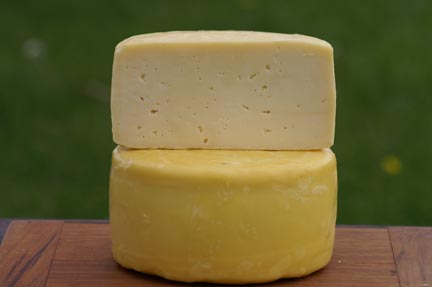
Well so much for Practicing Physicians!
Apparently a virus did start all of this . he knew all along and said we had a discussion about it. Nope. He was on amout my water consumbtion habits (tea actually) and blurred visions. I question one things, and boom cure and bye! No problems he was a wanker anyways.
Sold a 25# wheel to Cheese Shop at Wine Sense in Rochester. They apparently sold a wheel in a day. I had this big one and thought it would be a good venue for it.
Just getting the processing schedule up again. Have LOTS AND LOTA of cheese to make to recover my stores after the disease.
Picture is of Honey Gouda. My pride and joy.
Tuesday, October 03, 2006
Trying for Normal
Went with Lisa to Syracuse. She is having issues with her neck and needed help with egg boxes. I needed to get out and try this Mexican restaurant she kept telling me about.
Sold 11 1/2 wheels of cheese last week. Most via mail. That is interesting. Beeswax doesn't hold up well in the mail. I have to research better ways to pack the cheese and break down and get the polar tech freezer blocks like I had with the meat for Farmer's Markets in MA. Found a great Mail & Ship kinda place in Utica when the Frontier server crapped out and I couldn't get UPS labels or a pick up. Cheaper by 10% to ship and they can send FedEx or UPS, which ever is cheaper. I think I will focus on the Local Harvest and eCommerce thing after all.
Still have the nervous rash. That is what I figure it is...nerves. Forget the meds. More yucky side effects than the origional symptom. You know, no sleep in 10 days, swolen face, confusion and lack of reasoning skills, constipation, blurred vision and spontanious asthma attacks! I'll take the migrating rash thank you verrrrry much!
Renate cannot make cheese until she gets a cooler. No space. Ordering the 6 x 10 walk in pretty quick. We took the shed down a couple of weekends ago now. Well all but the part Dave HAD to keep. He doesn't want it now. Didn't think he would, but it is like the old tee-shirt that guys just cannot throw away. Rats dug out the west side of that foundation. No signs of them there now. I think I may have to dig the whole thing out and start cement all over again.
Tim still has to get feta out of my cooler. He didn't make Hamilton last weekend. 24 goats to milk in the spring. I cannot find him free money. I hate to admit, but he will have to take on some debt to get started and try for grants for the cheese part. He does seem a lot happier now that he doesn't have that IBA giant on his back.
Travis and Chris said they found the blogs. Here I thought this was under the radar... That is okay. I guess I will not be able to vent quite so much ;~>. Well, off to find the tv remote so Claire can watch the Wallace & Gromit Ware Rabbit DVD we got today! Woohoo, no more materialistic princess toys! I like the idea of "you only have $x.XX to spend. I am learning what those cost and ...oops it isn't in the budget, let us buy this educational kinda book or this DVD that is quite entertaining and doesn't involve the Disney Paris Hilton!
Sold 11 1/2 wheels of cheese last week. Most via mail. That is interesting. Beeswax doesn't hold up well in the mail. I have to research better ways to pack the cheese and break down and get the polar tech freezer blocks like I had with the meat for Farmer's Markets in MA. Found a great Mail & Ship kinda place in Utica when the Frontier server crapped out and I couldn't get UPS labels or a pick up. Cheaper by 10% to ship and they can send FedEx or UPS, which ever is cheaper. I think I will focus on the Local Harvest and eCommerce thing after all.
Still have the nervous rash. That is what I figure it is...nerves. Forget the meds. More yucky side effects than the origional symptom. You know, no sleep in 10 days, swolen face, confusion and lack of reasoning skills, constipation, blurred vision and spontanious asthma attacks! I'll take the migrating rash thank you verrrrry much!
Renate cannot make cheese until she gets a cooler. No space. Ordering the 6 x 10 walk in pretty quick. We took the shed down a couple of weekends ago now. Well all but the part Dave HAD to keep. He doesn't want it now. Didn't think he would, but it is like the old tee-shirt that guys just cannot throw away. Rats dug out the west side of that foundation. No signs of them there now. I think I may have to dig the whole thing out and start cement all over again.
Tim still has to get feta out of my cooler. He didn't make Hamilton last weekend. 24 goats to milk in the spring. I cannot find him free money. I hate to admit, but he will have to take on some debt to get started and try for grants for the cheese part. He does seem a lot happier now that he doesn't have that IBA giant on his back.
Travis and Chris said they found the blogs. Here I thought this was under the radar... That is okay. I guess I will not be able to vent quite so much ;~>. Well, off to find the tv remote so Claire can watch the Wallace & Gromit Ware Rabbit DVD we got today! Woohoo, no more materialistic princess toys! I like the idea of "you only have $x.XX to spend. I am learning what those cost and ...oops it isn't in the budget, let us buy this educational kinda book or this DVD that is quite entertaining and doesn't involve the Disney Paris Hilton!
Monday, September 18, 2006
Perspectives
Being sick has given me time to think. That and I've done a lot of baking. The house gets cleaned more often. Still cannot mow the lawn. Don't push it unless you're willing to pay the consequences kind of an illness.
Renate and Tim have been making cheese. Tim helped at the Farmer's Market on Saturday. Thank God. Made more $$ now that the college students are back and the competition bought a half pound of cheese.
I bought the Kadova molds. I'm looking into leasing the aging coolers.
I don't trust doctors any more. I think that it is a significantly arbitrary profession. I hate feeling like Fuzzy the Guinea Pig. Here, try this combination of 7 medications and call me tomorrow to see how you are doing... An actual conversation with one Dr.
Renate and Tim have been making cheese. Tim helped at the Farmer's Market on Saturday. Thank God. Made more $$ now that the college students are back and the competition bought a half pound of cheese.
I bought the Kadova molds. I'm looking into leasing the aging coolers.
I don't trust doctors any more. I think that it is a significantly arbitrary profession. I hate feeling like Fuzzy the Guinea Pig. Here, try this combination of 7 medications and call me tomorrow to see how you are doing... An actual conversation with one Dr.
Sunday, September 03, 2006
too damn sick to care
Well, it had to finally happen. I am on this thin string of "to do" lists and schedules. Wanna know how to make your life come crashing to a halt? Get sick. Get so sick that it costs you a lot of money to learn that Dr.'s don't know a hell of a lot and that you may be so sick it ends everything you have worked for.
It isn't that bad yet, but having severe airway constriction problems associated with medication you were given for an allergic reaction to something is down right scarry.
I also learned another lesson. Forget making sure every one around your environment is happy and content with you. Man, I am too tired of making everything so fluffy and wonderful for people. The world gives you choices. You have to make ones on your own and be happy with what you have given to you... or change. I am not going to appologize any more, because when I am on my own and scared to death of the asthma attack I feel coming on (which I never had to deal with until this week), I don't need to be yelled at because your life sucks!
Angre is what makes people lonely. I am not angry. I will not surround myself with angry people who I think I can help anymore. Piss off! I want peace and to make a living doing something I feel good about. I am happy there. I do have a problem bending over backwards for people. Forget that. I need to focus on "mi familia".
Now back downstairs to take another drug that will make me not sleep for days and give me crushing heartburn or worse, another of those dreaded asthma attacks...
It isn't that bad yet, but having severe airway constriction problems associated with medication you were given for an allergic reaction to something is down right scarry.
I also learned another lesson. Forget making sure every one around your environment is happy and content with you. Man, I am too tired of making everything so fluffy and wonderful for people. The world gives you choices. You have to make ones on your own and be happy with what you have given to you... or change. I am not going to appologize any more, because when I am on my own and scared to death of the asthma attack I feel coming on (which I never had to deal with until this week), I don't need to be yelled at because your life sucks!
Angre is what makes people lonely. I am not angry. I will not surround myself with angry people who I think I can help anymore. Piss off! I want peace and to make a living doing something I feel good about. I am happy there. I do have a problem bending over backwards for people. Forget that. I need to focus on "mi familia".
Now back downstairs to take another drug that will make me not sleep for days and give me crushing heartburn or worse, another of those dreaded asthma attacks...
Saturday, August 26, 2006
bread
Ok. I'm a farmer and I only just today baked a yeast bread! I've been planning and scheming about it for weeks. First the organic white bread flour, then the wheat flour. Active yeast purchased a month ago and kept in the fridge. Have sea salt because of cheese making.
Made a "simple loaf". White flour for the first bread. Immediately wanted to make many many many more loaves after the first try came out quite edible. Claire ate almost the entire first loaf. Well, she helped Dave and I eat a large chunk of it.
I also made simple breads and cakes to use up the yogurt I made earlier in the week. Yup, becoming a homemaker. Dave figures I need an Amish bonnet or something. Claire figured that was ok as long as she can get the cart and horse to go down the road like these boys she saw on one of her trips to see Grammy and Grampy.
Bought this new Ecover floor detergent when I dropped cheese off at Syracuse Coop. Another floor cleaner that I don't feel sick around. Woohoo. I am really liking the Ecover brand. Very good soap to clean cheese cloth with in the first wash. I also use the sterilized washing machine and another rinse using 100 ppm bleach. Line dried and it is fresh as a country breeze (before the manure spreader goes by the window).
Got the photos and permissions out to Jeff for the book. Cheese books are great books. I'll have another Christmas gift for the family baskets. This one they will not moan over, like the technical ones I drool over. Nice and fluffy with pictures and stories about farmers and cheese. Perfect for gifts. That and I can sell them at the farm stand.
Costing out low velocity coolers. Not too bad with some of these internet companies. I think we may be able to install ourselves. Shall see.
Made a "simple loaf". White flour for the first bread. Immediately wanted to make many many many more loaves after the first try came out quite edible. Claire ate almost the entire first loaf. Well, she helped Dave and I eat a large chunk of it.
I also made simple breads and cakes to use up the yogurt I made earlier in the week. Yup, becoming a homemaker. Dave figures I need an Amish bonnet or something. Claire figured that was ok as long as she can get the cart and horse to go down the road like these boys she saw on one of her trips to see Grammy and Grampy.
Bought this new Ecover floor detergent when I dropped cheese off at Syracuse Coop. Another floor cleaner that I don't feel sick around. Woohoo. I am really liking the Ecover brand. Very good soap to clean cheese cloth with in the first wash. I also use the sterilized washing machine and another rinse using 100 ppm bleach. Line dried and it is fresh as a country breeze (before the manure spreader goes by the window).
Got the photos and permissions out to Jeff for the book. Cheese books are great books. I'll have another Christmas gift for the family baskets. This one they will not moan over, like the technical ones I drool over. Nice and fluffy with pictures and stories about farmers and cheese. Perfect for gifts. That and I can sell them at the farm stand.
Costing out low velocity coolers. Not too bad with some of these internet companies. I think we may be able to install ourselves. Shall see.
Saturday, August 19, 2006
Milk cans and cutting boards
Went to the antique fair again. Dave and Claire went too. Claire wanted to get food and see Renate. I wanted to get cutting boards and something to drink. Dave saw ss milk cans from the road and wanted the daily meal(s).
Mission accomplished.
Mission accomplished.
Friday, August 18, 2006
Deliveries
I should deliver cheese when I am alone. I love to have Claire and Dave, only with the truck, SQUISH! My knee barely supported me by the time we got to Syracuse. On the way home, Dave had me drive. He seems to take up more room when he is in the middle. My shoulder hurts and he kept doing this shoulder twitching thing. Calire waited until the last 3 minutes to sleep, so Dave sat in truck. She then slept until just outside of Bouckville.
Dave Whitman came by. I gave him rent and we talked perennials. He has an awsome collection of perennials. Not a good marketer (his own admission). I think his prices and location are reasonable. I'll be buying some shade stuff like vinca, hosta and sweet woodruff. He also mentioned another one that would go well under the stairs below the cut & wrap room.
Dropped the last of the scrap metal (horse hay feeder we bought for the feed pan and a spring tooth harrow). Had to stop for lunch at the diner there. Not a bad little place. They could have toasted the bread for the shaved ham and cheese sandwish and I think they use canned pineapple for the coleslaw, but otherwise better than the other diners in Vernon. The fellows unloaded us and were pretty decent to talk to. Auction rats vary. Seems this group of guys were pretty decent to the lads while they off loaded equipment all week.
Have to get ready for the Farmers' market tomorrow. Signs, pack everything, etc...
Dave Whitman came by. I gave him rent and we talked perennials. He has an awsome collection of perennials. Not a good marketer (his own admission). I think his prices and location are reasonable. I'll be buying some shade stuff like vinca, hosta and sweet woodruff. He also mentioned another one that would go well under the stairs below the cut & wrap room.
Dropped the last of the scrap metal (horse hay feeder we bought for the feed pan and a spring tooth harrow). Had to stop for lunch at the diner there. Not a bad little place. They could have toasted the bread for the shaved ham and cheese sandwish and I think they use canned pineapple for the coleslaw, but otherwise better than the other diners in Vernon. The fellows unloaded us and were pretty decent to talk to. Auction rats vary. Seems this group of guys were pretty decent to the lads while they off loaded equipment all week.
Have to get ready for the Farmers' market tomorrow. Signs, pack everything, etc...
Thursday, August 17, 2006
Antiques and Cheese
Drained the raw milk Quark. Giving the bulk of it to Shirley considering it was their milk I was working with. Travis and Matt want some too. I'll probably give the last of it to Renate and maybe eat a wee bit myself.
Renate took some baby Gouda's to sell at the Antique show in Bouckville. She sold one baby last time I talked to her. I am not sure if Tom will try the rest, or if she will wait until she goes tomorrow. I hesitate to sell at that festival, even if it is in my back yard. Seems that there is more weather than profits for food type vendors. I guess it would be better than a day at a rural market like Hamilton, but I have this feeling about the place.
I still think that I need to break down and forgo sleep to sell at the Greenmarkets in NYC. I HATE that idea. I don't get the sustainability concept of 3 1/2 hours of driving one way, hanging around for hours and then coming home... I'd have to do deliveries and all. You know have $2-3000 of product into the region at a wack. I think I will consider the attack next year, if hubby will work with me on this one...
Priced out some of the building costs for aging facility. I hate this reach in cooler here, slide in box there, drain table until bloom if the cooler if full thing... I'm up to my eye balls in cheese. Heading to Syracuse to sell as much as possible tomorrow. To heck with the Farmer's market here in Hamilton. I need the room... To go into partnership for aging facility or more debt? That is the question???
Saw the most bizzaar thing at the antique show. A kinda "I loved him so much I had to kill him" kinda thing. Chickens meet taxidermy. Some beautiful rare and some common, yet lovely feathers. The heads were odd, if not horror show wrong. I was wigged out. I liked this one cupboard (narrow, perfect in the bathroom), but opened it out to find two more stuffed birds in pretend nests... Had to move on. Stuffed chickens!
Claire and I are to eat and sleep early. LOOOOOOOONG day ahead tomorrow. At least Dave is done with the cement at Tom's for now. We have to bring one mroe load to Burton's. A horse feeder bought at auction for the waterer in it (sheep) and a spring tooth harrow that Dave bought because it was cheap and he had to bid (an auction rat habit that I am mildly prone to as well). He got a better one a few weeks later, so now to remove the farm of excess scrap metal...
Renate took some baby Gouda's to sell at the Antique show in Bouckville. She sold one baby last time I talked to her. I am not sure if Tom will try the rest, or if she will wait until she goes tomorrow. I hesitate to sell at that festival, even if it is in my back yard. Seems that there is more weather than profits for food type vendors. I guess it would be better than a day at a rural market like Hamilton, but I have this feeling about the place.
I still think that I need to break down and forgo sleep to sell at the Greenmarkets in NYC. I HATE that idea. I don't get the sustainability concept of 3 1/2 hours of driving one way, hanging around for hours and then coming home... I'd have to do deliveries and all. You know have $2-3000 of product into the region at a wack. I think I will consider the attack next year, if hubby will work with me on this one...
Priced out some of the building costs for aging facility. I hate this reach in cooler here, slide in box there, drain table until bloom if the cooler if full thing... I'm up to my eye balls in cheese. Heading to Syracuse to sell as much as possible tomorrow. To heck with the Farmer's market here in Hamilton. I need the room... To go into partnership for aging facility or more debt? That is the question???
Saw the most bizzaar thing at the antique show. A kinda "I loved him so much I had to kill him" kinda thing. Chickens meet taxidermy. Some beautiful rare and some common, yet lovely feathers. The heads were odd, if not horror show wrong. I was wigged out. I liked this one cupboard (narrow, perfect in the bathroom), but opened it out to find two more stuffed birds in pretend nests... Had to move on. Stuffed chickens!
Claire and I are to eat and sleep early. LOOOOOOOONG day ahead tomorrow. At least Dave is done with the cement at Tom's for now. We have to bring one mroe load to Burton's. A horse feeder bought at auction for the waterer in it (sheep) and a spring tooth harrow that Dave bought because it was cheap and he had to bid (an auction rat habit that I am mildly prone to as well). He got a better one a few weeks later, so now to remove the farm of excess scrap metal...
Wednesday, August 16, 2006
Summer Sweat
Well, the weather has been cool. We are just in that time during the summer when one tries to catch up from poor weather earlier in the year and start preparations for winter.
Jeff's compresser went on bulk tank. Got some free milk for cheese experiments.
Dave is up to Tom's all weel trying to get the barn as close to done as he can in a week. They are pouring cement on the west side. He (and Nolan when the wind shifts) have been working on the forms. Tom needs to change focus or pick up a hammer with the milk house side of the project.
Made a cheddar earlier in the week. I'll cloth bind it after a wee nap.
Renate had maybe 3 hours of sleep after wine and guests. She needed to leave early to take a nap at the antique show. They are set up behind the Coop Gallery. Lisa and I will trawl trough the market on Thursday. I have to do deliveries into the Syracuse area on Friday. Was hoping to get some Fresh Mozz. curd done as well...
Priced the building yesterday. NOt sure how much or if it will fly cash flow wise this year.
Need nap. I need beauty sleep (especially after seeing the reaction from the library ladies when I returned those books...I guess I am a zombie).
Jeff's compresser went on bulk tank. Got some free milk for cheese experiments.
Dave is up to Tom's all weel trying to get the barn as close to done as he can in a week. They are pouring cement on the west side. He (and Nolan when the wind shifts) have been working on the forms. Tom needs to change focus or pick up a hammer with the milk house side of the project.
Made a cheddar earlier in the week. I'll cloth bind it after a wee nap.
Renate had maybe 3 hours of sleep after wine and guests. She needed to leave early to take a nap at the antique show. They are set up behind the Coop Gallery. Lisa and I will trawl trough the market on Thursday. I have to do deliveries into the Syracuse area on Friday. Was hoping to get some Fresh Mozz. curd done as well...
Priced the building yesterday. NOt sure how much or if it will fly cash flow wise this year.
Need nap. I need beauty sleep (especially after seeing the reaction from the library ladies when I returned those books...I guess I am a zombie).
Sunday, August 13, 2006
Oil Dependant or Not Oil Dependant...
Well, we bought Tom Montieth's bale wrapper. I thought it was to make forage harvesting a "one man's job." Nope. I have to drop everything to run the wrapper. It has made forage harvesting more helper dependant. It has cost me in cheese. Yup, cheese. I got to rinds too late after having to drop my life for this new boy toy. Pig food. Could have saved them I guess, but I don't like the grease that developed by waiting so long to get to them. Too warm in plant.
Theoretically, it is suppose to make better feed that haylege. I read that in a seed catalogue. We have a little more time to work the kinks out of this system. I think it will work with time (and not a first try with the BMR sorghum sudan grass...).
It does use a lot of plastic. 34 bales out of the roll. 20" wrap at $79-80... I want Dave to see what he thinks the real cost is. Fuel, time, wrap, string... I wonder if they can make this wrap from corn plastic, or if it is oil derived plastic...
Theoretically, it is suppose to make better feed that haylege. I read that in a seed catalogue. We have a little more time to work the kinks out of this system. I think it will work with time (and not a first try with the BMR sorghum sudan grass...).
It does use a lot of plastic. 34 bales out of the roll. 20" wrap at $79-80... I want Dave to see what he thinks the real cost is. Fuel, time, wrap, string... I wonder if they can make this wrap from corn plastic, or if it is oil derived plastic...
Subscribe to:
Posts (Atom)