That was the name of a restaurant I went to a couple of times in my youth. It was in Amherst. Maybe it was the Four Seasons... I don't remember.
There is grant season. I'm in that now. I wrote a grant and a quickie b.plan for this couple in the north country. It is due today. They need signatures this year, so I have to hand deliver it. FUN FUN FUN.
The year generally starts with the conference season. This is when the non-profits and government folks feel they should educate us farmers. From the farmer's perspective this is more of a time to get off the farm and socialize with others. The bonus is a workshop that offers something useful or entertaining.
Generally there are the NOFA winter conferences. This is where the organic types meet. I've gleaned great speakers at these conferences. Great food generally as well. Laid back atmosphere. You tend to walk away saying the word "basically" quite often. Odd little word. Quite contagious.
There are the Direct marketing Conferences. New York has one. There is also a northeast one. I think the New England ones or any workshops with Abbott Orchards in Baldwinsville are CRAZY useful. I only wish there was a workshop on displays at farmers markets. That is where my natural utilitarianism comes in. I respect the multi layered vendors. They seem to achieve the enthusiasm of the typical consumer.
Haying season. That starts at the end of may (chopped haylege) to snow flies. At times I've seen farmers baling hay with snow flying. Farmers get cranked at this time of year. Well my farmer anyways. It is quite a bit of work. I've been trying to milk at night to make marital bliss extend a little bit.
There is planting season. This generally starts with plowing, harrowing, planting... There are variations that can include no-till planting, deep plowing, spraying for various plant ailments and critters. We tend to let sod stay sod. This BMR experiment is an exception. Around here morons try to plant as soon as March or April and get the corn seed in early enough to rot or freeze. It is the biggest and fastest mentality in a way.
We have a lambing/kidding season in the late winter and early fall. I tend to leave the boys in lately. Not how I'd like to do things by any means, but the cows take presidence and materials and equipment and money... kinda why I sold most all the breeding ewes to Green Rabbit.
I hibernate in the winter. I guess that is a season. I want to get some of those special day light lights. Suppose to help with moods and general well being. That is my recovery season.
Holiday season tends to come at the same time as pay for winter feed season. That means that we don't generally have much in the way of holidays. Well, that is except for the gift giving that our families do. I prefer the food tradition side of things anyways. That and Claire is getting into crafts.
So onto Albany to complete grant season obligations...
Tuesday, June 20, 2006

Monday, June 19, 2006
Chesterfield
This is our old plac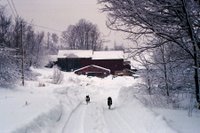 e. Well part of the place. Galedog and Abel are running up the donkey path that led to our humble Cape out behind the barns. Chesterfield was an odd litte place. The barn was a New England Bank barn on four levels with a stable for the cows out behind. It was part of the Bisbee estate. Old Allen always let us know that it was still the Bisbee farm no matter how much Dave changed or improved the place.
So, this is where it all started. I met Dave in a hay barn here at this farm. I bought some cheap first cut meadow hay. Only fit for sheep and beef heifers. I think I paid $5/bale or something for that rubbish. Well, it was not exactly love at first site, but we seemed to have this thing in common. We were sick of wealthy people and non-profits telling us how to run our farms.
For me it was the end of a horrid "Slaughterhouse project". For Dave it was Community Involved in Selective Agriculture. That is what a lot of hilltown farmers called it anyways. Either way you play the game, the deal is that unless you are a "pretty person" and played the games they outlined, they used and abused you.
Dave was processing his own milk then. My housemate told me that this was a great example of successful agriculture in New England. I think that the best thing it did was improve cash flow. I think success depended on having a number of children and their friends offering cheap labor. Well, cash flow, a distributor and cheap labor.
There were the usual cast of characters that are attracted to a farm. There was the contractor, Dunnovan, Dave's farm help - Bruce, Dipper - the neighbor (and his clan which is now out here in NY), etc. There were also the various regulars at the farm stand. There was Kessie, the guy who paid in pennies (always one short), Mandy, etc. Jim lived next door with his sister and girlfriend. He also has a sweet daughter that was there too. Dave sold him that building. Later Janice got the property in the center of town too.
The Bisbee's had this Mill Museum across the street. We helped out on occassion. Allen's dream. It was a pain on the days they had events because people seemed to think our farm was a public parking lot. Allen said it was, so they parked there. Kinda forgot that he didn't own the place anymore.
I miss and don't miss the place. I miss A1 pizza in Williamsburg. They made better pizza that the Italians here in Central NY. Greek guy named Con owned the place. It was run by El Salvadorians. We enjoyed them. I missed good restaurants. It is far and few between to find a decent meal here. Expensive too.
The dairy plant was also a perfect place to make cheese. I only wish that I learned more about cheese when we were in MA. I think that we could have started making it there. I bet we could have made an easy transition to cheese. Boy was it easier to market in MA then here in WalMart happy Central New York.
OK, I sound sappy. I guess I am a wee nostalgic today. Going through photos does that to me. Trying to find photos of some of the dairy processing stuff to put into the Hill's b.plan. Well, gotta finish their grant.
 e. Well part of the place. Galedog and Abel are running up the donkey path that led to our humble Cape out behind the barns. Chesterfield was an odd litte place. The barn was a New England Bank barn on four levels with a stable for the cows out behind. It was part of the Bisbee estate. Old Allen always let us know that it was still the Bisbee farm no matter how much Dave changed or improved the place.
So, this is where it all started. I met Dave in a hay barn here at this farm. I bought some cheap first cut meadow hay. Only fit for sheep and beef heifers. I think I paid $5/bale or something for that rubbish. Well, it was not exactly love at first site, but we seemed to have this thing in common. We were sick of wealthy people and non-profits telling us how to run our farms.
For me it was the end of a horrid "Slaughterhouse project". For Dave it was Community Involved in Selective Agriculture. That is what a lot of hilltown farmers called it anyways. Either way you play the game, the deal is that unless you are a "pretty person" and played the games they outlined, they used and abused you.
Dave was processing his own milk then. My housemate told me that this was a great example of successful agriculture in New England. I think that the best thing it did was improve cash flow. I think success depended on having a number of children and their friends offering cheap labor. Well, cash flow, a distributor and cheap labor.
There were the usual cast of characters that are attracted to a farm. There was the contractor, Dunnovan, Dave's farm help - Bruce, Dipper - the neighbor (and his clan which is now out here in NY), etc. There were also the various regulars at the farm stand. There was Kessie, the guy who paid in pennies (always one short), Mandy, etc. Jim lived next door with his sister and girlfriend. He also has a sweet daughter that was there too. Dave sold him that building. Later Janice got the property in the center of town too.
The Bisbee's had this Mill Museum across the street. We helped out on occassion. Allen's dream. It was a pain on the days they had events because people seemed to think our farm was a public parking lot. Allen said it was, so they parked there. Kinda forgot that he didn't own the place anymore.
I miss and don't miss the place. I miss A1 pizza in Williamsburg. They made better pizza that the Italians here in Central NY. Greek guy named Con owned the place. It was run by El Salvadorians. We enjoyed them. I missed good restaurants. It is far and few between to find a decent meal here. Expensive too.
The dairy plant was also a perfect place to make cheese. I only wish that I learned more about cheese when we were in MA. I think that we could have started making it there. I bet we could have made an easy transition to cheese. Boy was it easier to market in MA then here in WalMart happy Central New York.
OK, I sound sappy. I guess I am a wee nostalgic today. Going through photos does that to me. Trying to find photos of some of the dairy processing stuff to put into the Hill's b.plan. Well, gotta finish their grant.
Me and the Cheese Vat
 Here is the photo of me and my cheese vat. I'm looking at Pete Dixon taking the photo. I am telling my Damrow vat to smile!! The facility was newly licensed here. That was my first batch of Honey Gouda. They baby's are in the brine (in the vat). What a long way I've come from that day.
Workshop photos

Donna sent on a couple of photos from the last cheese workshop.
This is Renate Nollen. She is also one of the people who come during regular weekly cheese processing days to help. She is interested in goats milk Gouda. Maybe Camambert or Crottin. Very dynamic person.
In this photo she is holding the cheeses she can take home to practice aging. There are cows milk Camamberts, goats milk Crottins and half Camamberts made with goats milk. It was a great workshop. We all learned a lot.
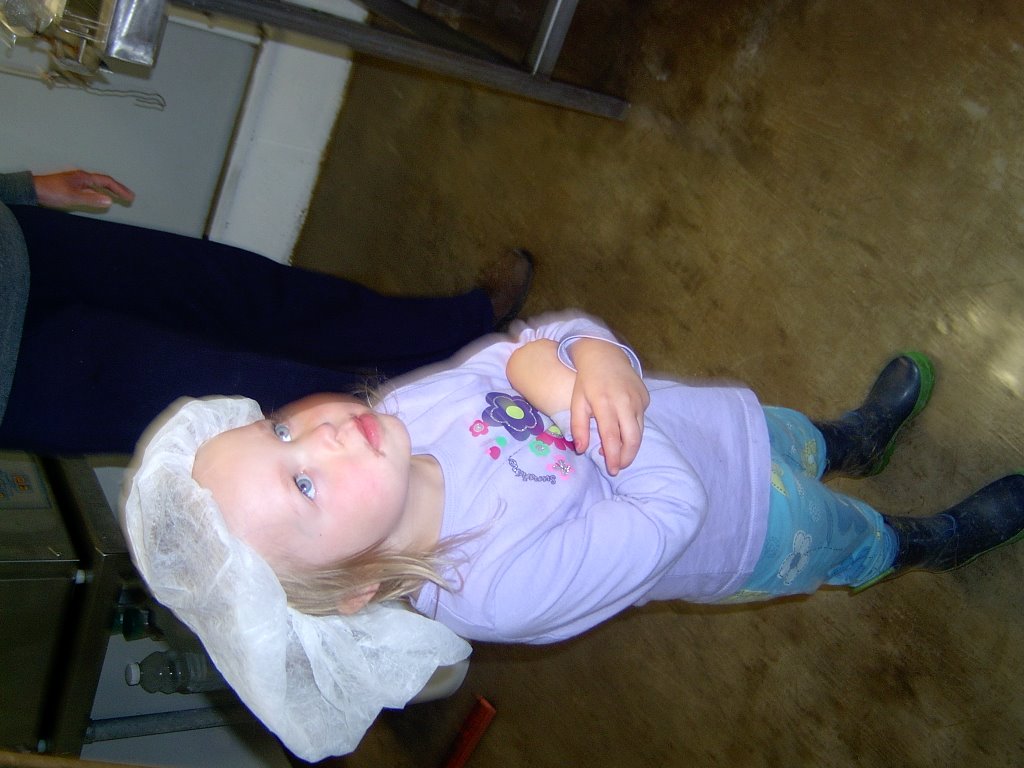
I also have this one of Claire. She is my daughter. She is VERY interested in anything that involves cheese and people. The photo is at the wrong angle. After I figure out how to get this in the right direction, you will just have to imagine what Claire looks like in her hair net.
The picture has part of my drain table/dutch press and the can rack in the back ground. A simple plant. I'll try to get more pictures on here, now that the high speed internet thing doesn't mean that uploading pictures take 15 minutes to load.
Saturday, June 17, 2006
What's with that Camper in your driveway?
I love rural people. They are crazy nosey. We have our itenerant carpenter friends back again (from honeymoon, etc). Jenny and Cecil brought their new camper out with them. A big, wanna be Airstreamer. because Dave is trying to get crops in, I suggested that they park the puppy in the driveway in front of the house. Ok, camper parked... they go for Chinese.
About every neighbor and friend has stopped by to ask about the camper. One asked how long they planned to stay this time. (I think he knew that they were in the sheep barn all winter). I told Rivington that they were gypsies who asked to park for the night. I think he belived me. Heck, he had illegal immigrants that the state got for him, why not have legal itinerants??
A neighboring farmer to the north has driven by a half dozen times. I think that also has something to do with Dave's use of antique varieties of equipment and the numbers of guests that we have staying at any given time. I think we should have has a B&B. I may have made money on these people.
Dave is humored. I think that the sedate life with Penny in the Cape his parents built for him in Chesterfield has been crazy changed since Gale, Floss and I came on the scene. But then, the itinerant carpenters are remenants of his life in Chesterfield. I only wish he'd get Donnavan and Jim to come out too. We need some more inteligent life out here.
About every neighbor and friend has stopped by to ask about the camper. One asked how long they planned to stay this time. (I think he knew that they were in the sheep barn all winter). I told Rivington that they were gypsies who asked to park for the night. I think he belived me. Heck, he had illegal immigrants that the state got for him, why not have legal itinerants??
A neighboring farmer to the north has driven by a half dozen times. I think that also has something to do with Dave's use of antique varieties of equipment and the numbers of guests that we have staying at any given time. I think we should have has a B&B. I may have made money on these people.
Dave is humored. I think that the sedate life with Penny in the Cape his parents built for him in Chesterfield has been crazy changed since Gale, Floss and I came on the scene. But then, the itinerant carpenters are remenants of his life in Chesterfield. I only wish he'd get Donnavan and Jim to come out too. We need some more inteligent life out here.
Friday, June 16, 2006
Desperate Farmwives
Well, it is a take on the favorite T.V. show, but I do think that I have a better plot line. We do have a heck of a group of characters and the day to day plot is funny. There are some serious moments as well. Those are generally part of the calm before the Belly Laughing moments.
I want to take a class on screen writting. Between the daily happenings, there are also the Mountain Street Memories of Dave's youth and the Nomadic Shepherd days of my earlier attempts at farming and horsemanship.
I'm thinking something along the lines of Northern Exposure, only with a true American Rural twist.
We have Liberals, Conservatives, Born Again Catholics and Pentacostals, Sheep Farmers, a vet who sleeps in his car, Bob and Tom, a Christian logger, gypsie carpenters (Jenny & Cecil), etc. I dunno. Our life is the cross roads of conventional and organic agriculture. We are associated with people who work for millionaire "Farmers" and those almost loosing thier shirts, the wanna be wealthy suburban farmers... I do think that there is something here. A real cross section of rural American with the whole opportunity to shed light on the true nature of living in rural America today!
I'm thinking here... Heck if I cannot make money as a farmer, maybe we can all make money on the whole farming experience??
I want to take a class on screen writting. Between the daily happenings, there are also the Mountain Street Memories of Dave's youth and the Nomadic Shepherd days of my earlier attempts at farming and horsemanship.
I'm thinking something along the lines of Northern Exposure, only with a true American Rural twist.
We have Liberals, Conservatives, Born Again Catholics and Pentacostals, Sheep Farmers, a vet who sleeps in his car, Bob and Tom, a Christian logger, gypsie carpenters (Jenny & Cecil), etc. I dunno. Our life is the cross roads of conventional and organic agriculture. We are associated with people who work for millionaire "Farmers" and those almost loosing thier shirts, the wanna be wealthy suburban farmers... I do think that there is something here. A real cross section of rural American with the whole opportunity to shed light on the true nature of living in rural America today!
I'm thinking here... Heck if I cannot make money as a farmer, maybe we can all make money on the whole farming experience??
Bob and Tom show
Dave use to listen to this morning radio program called the bob and Tom show. She sprinkled classic style rock in with the usual I'm too funny for my shoes morning program jokes and the like. Definately a male program. Chicks can get into it on odd mornings. It isn't my NPR. In fact, that is why he doesn't listen to the program right now. NPR. I was trying to get some news one morning and switched the channel. We have not been able to go back to that radio station since. Something about a metal and cement block barn I guess.
Onto Dave's real life Bob & Tom show. Tom is our neighbor. A Cornell educated dairy farmer. Devout Christian. A pretty good example of God wanting to see what happens to a man's phyche if she puts a lot of road blocks in his way. Bob is, well Bob. He started out as Hay Bob. Became our silo unloader. Lost his position as milker after we found our dislike for his way of handling cows. Right now he is Wood Bob with sprinklings of Forage Bob. (thinks cord wood is his next lottery and is helping Dave get forages in to get use of our Hesston tractor ~ to get wood in).
Forages. What a cluster f*^%#. Dave is trying like heck to get it in with sprinklings of those two making things more difficult and people like Aaron (veggie guy down road), etc. making demands of time and equipment while Dave is trying to get our stuff in. Dave figures he should start drinking. I've tried to join in, but with our cash flow right now a beer a night is all we can afford. Can't become a drunk if you want to pay your bills on time (sort of).
Bob is also trying to figure out how to do little or nothing and stay under the radar of his wife (didn't get divorse because it costs money) and his girlfrield. Both of which have children by him. Neight of whom get decent support from him. In my book it is reason enough to ban him from our place, but I think that it is often the case that people are often in the sphere that have a crappier life than you ~ if only to make your life seem less hellish. Well Bob's girlfriend got the court to send a letter to Bob's current employer. This employer is paying cash and pretty firmly doesn't want to have anything to do with court ordered payments. Bob was suppose to take care of that on his own. (Mmm). Boss was thinking about putting a trailer up for Bob. When asked about what he was going to do about his "situation", Bob says "nothing". About possible jail time, Bob says "I guess I'll be going to jail". Not a good argument for puttign a trailer in or keeping the guy employed, but in Bob's little mind nothing is wrong.
I'm not even going to go into the Tom side of the equation. NICE GUY, but I'm thinking ADD or something. I think that if he can focus on the "Big picture", he'd see that God has given him all of the signs to tell him to get out of Dairy farming... His wife finished her education and has tenure, two barns burnt down, fell down silo, lost two farms (one rented), etc. It isn't so much a sign from God he is looking for, he is looking for God to tell him to follow this dream to stay in business. It is like having God validate what he does or something. I think it is a crutch. He needs to stop and figure out his own goals and how to achieve them. God will appreciate it, big time.
Wow, all this talk about God. I must be in Central New York.
Onto Dave's real life Bob & Tom show. Tom is our neighbor. A Cornell educated dairy farmer. Devout Christian. A pretty good example of God wanting to see what happens to a man's phyche if she puts a lot of road blocks in his way. Bob is, well Bob. He started out as Hay Bob. Became our silo unloader. Lost his position as milker after we found our dislike for his way of handling cows. Right now he is Wood Bob with sprinklings of Forage Bob. (thinks cord wood is his next lottery and is helping Dave get forages in to get use of our Hesston tractor ~ to get wood in).
Forages. What a cluster f*^%#. Dave is trying like heck to get it in with sprinklings of those two making things more difficult and people like Aaron (veggie guy down road), etc. making demands of time and equipment while Dave is trying to get our stuff in. Dave figures he should start drinking. I've tried to join in, but with our cash flow right now a beer a night is all we can afford. Can't become a drunk if you want to pay your bills on time (sort of).
Bob is also trying to figure out how to do little or nothing and stay under the radar of his wife (didn't get divorse because it costs money) and his girlfrield. Both of which have children by him. Neight of whom get decent support from him. In my book it is reason enough to ban him from our place, but I think that it is often the case that people are often in the sphere that have a crappier life than you ~ if only to make your life seem less hellish. Well Bob's girlfriend got the court to send a letter to Bob's current employer. This employer is paying cash and pretty firmly doesn't want to have anything to do with court ordered payments. Bob was suppose to take care of that on his own. (Mmm). Boss was thinking about putting a trailer up for Bob. When asked about what he was going to do about his "situation", Bob says "nothing". About possible jail time, Bob says "I guess I'll be going to jail". Not a good argument for puttign a trailer in or keeping the guy employed, but in Bob's little mind nothing is wrong.
I'm not even going to go into the Tom side of the equation. NICE GUY, but I'm thinking ADD or something. I think that if he can focus on the "Big picture", he'd see that God has given him all of the signs to tell him to get out of Dairy farming... His wife finished her education and has tenure, two barns burnt down, fell down silo, lost two farms (one rented), etc. It isn't so much a sign from God he is looking for, he is looking for God to tell him to follow this dream to stay in business. It is like having God validate what he does or something. I think it is a crutch. He needs to stop and figure out his own goals and how to achieve them. God will appreciate it, big time.
Wow, all this talk about God. I must be in Central New York.
Tuesday, June 06, 2006
Spreadsheets
It is funny how lovely you can make predictions with working spreadsheets. You know, if everything goes perfect and I make XXX pounds of cheese a week, I can pay all of my bills and make $50,000/year in YEAR ONE!!!!!!
Right.
I love to get these spreadsheets to people. They play with them. They get excited. "I've decided to sell commodity style cheddar for $10/#, because I think I'll make $100,000 right off...waaahaaahoooooooo"
The reality is that forages have to come in and the four year old needs watching and the heifers broke through the fence again and the pigs broke through the gate and the farmers market was rained out for two weekends in a row... Well, not all true, but that could have happened.
The Farmland Viability grants are due on the 20th or so. Grants are not the end all of succeeding in a business. If you depend on a grant to get into or stay in a farming business (or any for that matter) you are not proposing a sustainable project. What would happen if you didn't get it? Many don't. Does that mean that you are out of business? How can you prove that you will not be out of business after the end of the grant cycle?
I got one last year. Didn't really need it. Wrote it to write one for myself. Kind of a shits and giggles kind of thing. Now I have to cashflow my cost share and actually do this stuff. Also it is a reimbursement kind of thing. Hence writting business plans and those spreadsheets and writing more grants for others. Have to cash flow my business plan and my grant now...
Man, I should be making cheese today. If I make 90 batches of Gouda this year, I can make $35,000...
Right.
I love to get these spreadsheets to people. They play with them. They get excited. "I've decided to sell commodity style cheddar for $10/#, because I think I'll make $100,000 right off...waaahaaahoooooooo"
The reality is that forages have to come in and the four year old needs watching and the heifers broke through the fence again and the pigs broke through the gate and the farmers market was rained out for two weekends in a row... Well, not all true, but that could have happened.
The Farmland Viability grants are due on the 20th or so. Grants are not the end all of succeeding in a business. If you depend on a grant to get into or stay in a farming business (or any for that matter) you are not proposing a sustainable project. What would happen if you didn't get it? Many don't. Does that mean that you are out of business? How can you prove that you will not be out of business after the end of the grant cycle?
I got one last year. Didn't really need it. Wrote it to write one for myself. Kind of a shits and giggles kind of thing. Now I have to cashflow my cost share and actually do this stuff. Also it is a reimbursement kind of thing. Hence writting business plans and those spreadsheets and writing more grants for others. Have to cash flow my business plan and my grant now...
Man, I should be making cheese today. If I make 90 batches of Gouda this year, I can make $35,000...
Monday, June 05, 2006
Michael Pollan's new article ~good read~
June 4, 2006
The Way We Live Now
New York Times Sunday Magazine
Mass Natural
By MICHAEL POLLAN
"Elitist" is just about the nastiest name you can call someone, or something, in America these days, a finely-honed term of derision in the culture wars, and "elitist" has stuck to organic food in this country like balsamic vinegar to mâche. Thirty years ago the rap on organic was a little different: back then the stuff was derided as hippie food, crunchy granola and bricklike brown bread for the unshaved set (male and female division). So for organic to be tagged as elitist may count as progress. But you knew it was over for John Kerry in the farm belt when his wife, Teresa, helpfully suggested to Missouri farmers that they go organic. Eating organic has been fixed in the collective imagination as an upper-middle-class luxury, a blue-state affectation as easy to mock as Volvos or lattes. On the cultural spectrum, organic stands at the far opposite extreme from Nascar or Wal-Mart.
But all this is about to change, now that Wal-Mart itself, the nation's largest grocer, has decided to take organic food seriously. (Nascar is not quite there yet.) Beginning later this year, Wal-Mart plans to roll out a complete selection of organic foods — food certified by the U.S.D.A. to have been grown without synthetic pesticides or fertilizers — in its nearly 4,000 stores. Just as significant, the company says it will price all this organic food at an eye-poppingly tiny premium over its already-cheap conventional food: the organic Cocoa Puffs and Oreos will cost only 10 percent more than the conventional kind. Organic food will soon be available to the tens of millions of Americans who now cannot afford it — indeed, who have little or no idea what the term even means. Organic food, which represents merely 2.5 percent of America's half-trillion-dollar food economy, is about to go mainstream. At a stroke, the argument that it is elitist will crumble.
This is good news indeed, for the American consumer and the American land. Or perhaps I should say for some of the American land and a great deal more of the land in places like Mexico and China, for Wal-Mart is bound to hasten the globalization of organic food. (Ten percent of organic food is imported today.) Like every other commodity that global corporations lay their hands on, organic food will henceforth come from wherever in the world it can be produced most cheaply. It is about to go the way of sneakers and MP3 players, becoming yet another rootless commodity circulating in the global economy.
Oh, but wait. . .I meant to talk about all the good that will come of Wal-Mart's commitment to organic. Sorry about that. When you're talking about global capitalism, it can be hard to separate the good news from the bad. Because of its scale and efficiency and notorious ruthlessness, Wal-Mart will force down the price of organics, and that is a good thing for all the consumers who can't afford to spend more for food than they already do. Wal-Mart will also educate the millions of Americans who don't yet know exactly what organic food is or precisely how it differs from conventionally grown food.
The vast expansion of organic farmland it will take to feed Wal-Mart's new appetite is also an unambiguous good for the world's environment, since it will result in substantially less pesticide and chemical fertilizer being applied to the land — somewhere. Whatever you think about the prospect of organic Coca-Cola, when it comes, and come it surely will, tens of thousands of acres of the world's cornfields — enough to make all that organic high-fructose corn syrup — will no longer receive an annual shower of pesticides like Atrazine. O.K., you're probably registering a flicker of cognitive dissonance at the conjunction of the words "organic" and "high-fructose corn syrup," but keep your eye for a moment on that Atrazine.
Atrazine is a powerful herbicide applied to 70 percent of America's cornfields. Traces of the chemical routinely turn up in American streams and wells and even in the rain; the F.D.A. also finds residues of Atrazine in our food.
So what? Well, the chemical, which was recently banned by the European Union, is a suspected carcinogen and endocrine disruptor that has been linked to low sperm counts among farmers. A couple of years ago, a U.C. Berkeley herpetologist named Tyrone Hayes, while doing research on behalf of Syngenta, Atrazine's manufacturer, found that even at concentrations as low as 0.1 part per billion, the herbicide will chemically emasculate a male frog, causing its gonads to produce eggs — in effect, turning males into hermaphrodites. Atrazine is often present in American waterways at much higher concentrations than 0.1 part per billion. But American regulators generally won't ban a pesticide until the bodies, or cancer cases, begin to pile up — until, that is, scientists can prove the link between the suspect molecule and illness in humans or ecological catastrophe. So Atrazine is, at least in the American food system, deemed innocent until proved guilty — a standard of proof extremely difficult to achieve, since it awaits the results of chemical testing on humans that we, rightly, don't perform.
I don't know about you, but as the father of an adolescent boy, I sort of like the idea of keeping such a molecule out of my son's diet, even if the scientists and nutritionists say they still don't have proof that organic food is any safer or healthier. I also like that growing food organically doesn't pollute the rivers and water table with nitrates from synthetic fertilizer or expose farm workers to toxic pesticides. And the fact that animals raised organically don't receive antibiotics or synthetic growth hormones. Sounds like a better agriculture to me — and Wal-Mart has just put the force of its great many supermarkets behind it.
But before you pour yourself a celebratory glass of Wal-Mart organic milk, you might want to ask a few questions about how the company plans to achieve its laudable goals. Assuming that it's possible at all, how exactly would Wal-Mart get the price of organic food down to a level just 10 percent higher than that of its everyday food? To do so would virtually guarantee that Wal-Mart's version of cheap organic food is not sustainable, at least not in any meaningful sense of that word. To index the price of organic to the price of conventional is to give up, right from the start, on the idea, once enshrined in the organic movement, that food should be priced not high or low but responsibly. As the organic movement has long maintained, cheap industrial food is cheap only because the real costs of producing it are not reflected in the price at the checkout. Rather, those costs are charged to the environment, in the form of soil depletion and pollution (industrial agriculture is now our biggest polluter); to the public purse, in the form of subsidies to conventional commodity farmers; to the public health, in the form of an epidemic of diabetes and obesity that is expected to cost the economy more than $100 billion per year; and to the welfare of the farm- and food-factory workers, not to mention the well-being of the animals we eat. As Wendell Berry once wrote, the motto of our conventional food system — at the center of which stands Wal-Mart, the biggest purveyor of cheap food in America — should be: Cheap at any price!
To say you can sell organic food for 10 percent more than you sell irresponsibly priced food suggests that you don't really get it — that you plan to bring business-as-usual principles of industrial "efficiency" and "economies of scale" to a system of food production that was supposed to mimic the logic of natural systems rather than that of the factory.
We have already seen what happens when the logic of the factory is applied to organic food production. The industrialization of organic agriculture, which Wal-Mart's involvement will only deepen, has already given us "organic feedlots" — two words that I never thought would find their way into the same clause. To supply the escalating demand for cheap organic milk, agribusiness companies are setting up 5,000-head dairies, often in the desert. These milking cows never touch a blade of grass, instead spending their days standing around a dry-lot "loafing area" munching organic grain — grain that takes a toll on both the animals' health (these ruminants evolved to eat grass, after all) and the nutritional value of their milk. But this is the sort of milk (deficient in beta-carotene and the "good fats" — like omega 3's and C.L.A. — that come from grazing cows on grass) we're going to see a lot more of in the supermarket as long as Wal-Mart determines to keep organic milk cheap.
We're also going to see more organic milk — and organic foods of all kinds — coming from places like New Zealand. The globalization of organic food is already well under way: at Whole Foods you can buy organic asparagus flown in from Argentina, raspberries from Mexico, grass-fed meat from New Zealand. In an era of energy scarcity, the purchase of such products does little to advance the ideal of sustainability that once upon a time animated the organic movement. These foods may contain no pesticides, but they are drenched in petroleum even so.
Whether produced domestically or not, organic meat will increasingly come not from mixed, polyculture farms growing a variety of species (a practice that makes it possible to recycle nutrients between plants and animals) but from ever-bigger Confined Animal Feeding Operations, or CAFO's, which, apart from using organic feed and abjuring antibiotics, are little different from their conventional counterparts. Yes, the federal organic rules say the animals should have "access to the outdoors," but in practice this often means providing them with a tiny exercise yard or, in the case of one organic egg producer in New England, a screened-in concrete "porch" — a view of the outdoors. Herein lies one of the deeper paradoxes of practicing organic agriculture on an industrial scale: big, single-species CAFO's are even more precarious than their conventional cousins, since they can't use antibiotics to keep the thousands of animals living in close confinement indoors from becoming sick. So organic CAFO-hands (to call them farmhands seems overly generous) keep the free ranging to a minimum and then keep their fingers crossed.
Wal-Mart will buy its organic food from whichever producers can produce it most cheaply, and these will not be the sort of farmers you picture when you hear the word "organic." Big supermarkets want to do business only with big farmers growing lots of the same thing, not because big monoculture farms are any more efficient (they aren't) but because it's easier to buy all your carrots from a single megafarm than to contract with hundreds of smaller growers. The "transaction costs" are lower, even when the price and the quality are the same. This is just one of the many ways in which the logic of industrial capitalism and the logic of biology on a farm come into conflict. At least in the short run, the logic of capitalism usually prevails.
Wal-Mart's push into the organic market won't do much for small organic farmers, that seems plain enough. But it may also spell trouble for the big growers it will favor. Wal-Mart has a reputation for driving down prices by squeezing its suppliers, especially after those suppliers have invested heavily to boost production to feed the Wal-Mart maw. Having done that, the supplier will find itself at Wal-Mart's mercy when the company decides it no longer wants to pay a price that enables the farmer to make a living. When that happens, the notion of responsibly priced food will be sacrificed to the imperatives of survival, and the pressure to cut corners will become irresistible.
Up to now, the federal organic standards have provided a bulwark against that pressure. Yet with the industrialization of organic, these rules are themselves coming under mounting pressure, and forgive my skepticism, but it's hard to believe that the lobbyists from Wal-Mart are going to play a constructive role in defending those standards from efforts to weaken them. Just this past year the Organic Trade Association used lobbyists who do work for Kraft Foods to move a bill through Congress that will make it easier to include synthetic ingredients in products labeled organic.
Organic is just a word, after all, and its definition now lies in the hands of the federal government, which means it is subject to all the usual political and economic forces at play in Washington. Inevitably, the drive to produce organic food cheaply will bring pressure to further weaken the regulations, and some of K Street's finest talent will soon be on the case. A few years ago a chicken producer in Georgia named Fieldale Farms persuaded its congressman to slip a helpful provision into an appropriations bill that would allow growers of organic chicken to substitute conventional chicken feed if the price of organic feed exceeded a certain level. That certainly makes life easier for a chicken producer when the price of organic corn is north of $5 a bushel, as it is today, and conventional corn south of $2. But in what sense is a chicken fed on conventional feed still organic? In no sense but the Orwellian one: because the government says it is.
After an outcry from consumers and some wiser heads in the organic industry, this new rule was repealed. The moral of the Fieldale story is that unless consumers and well-meaning organic producers remain vigilant and steadfast, the drive to make the price of organic foods competitive with that of conventional foods will hollow out the word and kill the organic goose, just when her golden eggs are luring so many big players into the water. Let's hope Wal-Mart recognizes that the extraordinary marketing magic of the word "organic" — a power that flows directly from our dissatisfaction with the very-cheap-food economy Wal-Mart has done so much to create — is a lot like the health of an organic chicken living in close confinement with thousands of other chickens in an organic CAFO, munching organic corn: fragile.
Michael Pollan, a contributing writer for the magazine, is the author, most recently, of "The Omnivore's Dilemma: A Natural History of Four Meals." He also teaches journalism at the University of California at Berkeley.
The Way We Live Now
New York Times Sunday Magazine
Mass Natural
By MICHAEL POLLAN
"Elitist" is just about the nastiest name you can call someone, or something, in America these days, a finely-honed term of derision in the culture wars, and "elitist" has stuck to organic food in this country like balsamic vinegar to mâche. Thirty years ago the rap on organic was a little different: back then the stuff was derided as hippie food, crunchy granola and bricklike brown bread for the unshaved set (male and female division). So for organic to be tagged as elitist may count as progress. But you knew it was over for John Kerry in the farm belt when his wife, Teresa, helpfully suggested to Missouri farmers that they go organic. Eating organic has been fixed in the collective imagination as an upper-middle-class luxury, a blue-state affectation as easy to mock as Volvos or lattes. On the cultural spectrum, organic stands at the far opposite extreme from Nascar or Wal-Mart.
But all this is about to change, now that Wal-Mart itself, the nation's largest grocer, has decided to take organic food seriously. (Nascar is not quite there yet.) Beginning later this year, Wal-Mart plans to roll out a complete selection of organic foods — food certified by the U.S.D.A. to have been grown without synthetic pesticides or fertilizers — in its nearly 4,000 stores. Just as significant, the company says it will price all this organic food at an eye-poppingly tiny premium over its already-cheap conventional food: the organic Cocoa Puffs and Oreos will cost only 10 percent more than the conventional kind. Organic food will soon be available to the tens of millions of Americans who now cannot afford it — indeed, who have little or no idea what the term even means. Organic food, which represents merely 2.5 percent of America's half-trillion-dollar food economy, is about to go mainstream. At a stroke, the argument that it is elitist will crumble.
This is good news indeed, for the American consumer and the American land. Or perhaps I should say for some of the American land and a great deal more of the land in places like Mexico and China, for Wal-Mart is bound to hasten the globalization of organic food. (Ten percent of organic food is imported today.) Like every other commodity that global corporations lay their hands on, organic food will henceforth come from wherever in the world it can be produced most cheaply. It is about to go the way of sneakers and MP3 players, becoming yet another rootless commodity circulating in the global economy.
Oh, but wait. . .I meant to talk about all the good that will come of Wal-Mart's commitment to organic. Sorry about that. When you're talking about global capitalism, it can be hard to separate the good news from the bad. Because of its scale and efficiency and notorious ruthlessness, Wal-Mart will force down the price of organics, and that is a good thing for all the consumers who can't afford to spend more for food than they already do. Wal-Mart will also educate the millions of Americans who don't yet know exactly what organic food is or precisely how it differs from conventionally grown food.
The vast expansion of organic farmland it will take to feed Wal-Mart's new appetite is also an unambiguous good for the world's environment, since it will result in substantially less pesticide and chemical fertilizer being applied to the land — somewhere. Whatever you think about the prospect of organic Coca-Cola, when it comes, and come it surely will, tens of thousands of acres of the world's cornfields — enough to make all that organic high-fructose corn syrup — will no longer receive an annual shower of pesticides like Atrazine. O.K., you're probably registering a flicker of cognitive dissonance at the conjunction of the words "organic" and "high-fructose corn syrup," but keep your eye for a moment on that Atrazine.
Atrazine is a powerful herbicide applied to 70 percent of America's cornfields. Traces of the chemical routinely turn up in American streams and wells and even in the rain; the F.D.A. also finds residues of Atrazine in our food.
So what? Well, the chemical, which was recently banned by the European Union, is a suspected carcinogen and endocrine disruptor that has been linked to low sperm counts among farmers. A couple of years ago, a U.C. Berkeley herpetologist named Tyrone Hayes, while doing research on behalf of Syngenta, Atrazine's manufacturer, found that even at concentrations as low as 0.1 part per billion, the herbicide will chemically emasculate a male frog, causing its gonads to produce eggs — in effect, turning males into hermaphrodites. Atrazine is often present in American waterways at much higher concentrations than 0.1 part per billion. But American regulators generally won't ban a pesticide until the bodies, or cancer cases, begin to pile up — until, that is, scientists can prove the link between the suspect molecule and illness in humans or ecological catastrophe. So Atrazine is, at least in the American food system, deemed innocent until proved guilty — a standard of proof extremely difficult to achieve, since it awaits the results of chemical testing on humans that we, rightly, don't perform.
I don't know about you, but as the father of an adolescent boy, I sort of like the idea of keeping such a molecule out of my son's diet, even if the scientists and nutritionists say they still don't have proof that organic food is any safer or healthier. I also like that growing food organically doesn't pollute the rivers and water table with nitrates from synthetic fertilizer or expose farm workers to toxic pesticides. And the fact that animals raised organically don't receive antibiotics or synthetic growth hormones. Sounds like a better agriculture to me — and Wal-Mart has just put the force of its great many supermarkets behind it.
But before you pour yourself a celebratory glass of Wal-Mart organic milk, you might want to ask a few questions about how the company plans to achieve its laudable goals. Assuming that it's possible at all, how exactly would Wal-Mart get the price of organic food down to a level just 10 percent higher than that of its everyday food? To do so would virtually guarantee that Wal-Mart's version of cheap organic food is not sustainable, at least not in any meaningful sense of that word. To index the price of organic to the price of conventional is to give up, right from the start, on the idea, once enshrined in the organic movement, that food should be priced not high or low but responsibly. As the organic movement has long maintained, cheap industrial food is cheap only because the real costs of producing it are not reflected in the price at the checkout. Rather, those costs are charged to the environment, in the form of soil depletion and pollution (industrial agriculture is now our biggest polluter); to the public purse, in the form of subsidies to conventional commodity farmers; to the public health, in the form of an epidemic of diabetes and obesity that is expected to cost the economy more than $100 billion per year; and to the welfare of the farm- and food-factory workers, not to mention the well-being of the animals we eat. As Wendell Berry once wrote, the motto of our conventional food system — at the center of which stands Wal-Mart, the biggest purveyor of cheap food in America — should be: Cheap at any price!
To say you can sell organic food for 10 percent more than you sell irresponsibly priced food suggests that you don't really get it — that you plan to bring business-as-usual principles of industrial "efficiency" and "economies of scale" to a system of food production that was supposed to mimic the logic of natural systems rather than that of the factory.
We have already seen what happens when the logic of the factory is applied to organic food production. The industrialization of organic agriculture, which Wal-Mart's involvement will only deepen, has already given us "organic feedlots" — two words that I never thought would find their way into the same clause. To supply the escalating demand for cheap organic milk, agribusiness companies are setting up 5,000-head dairies, often in the desert. These milking cows never touch a blade of grass, instead spending their days standing around a dry-lot "loafing area" munching organic grain — grain that takes a toll on both the animals' health (these ruminants evolved to eat grass, after all) and the nutritional value of their milk. But this is the sort of milk (deficient in beta-carotene and the "good fats" — like omega 3's and C.L.A. — that come from grazing cows on grass) we're going to see a lot more of in the supermarket as long as Wal-Mart determines to keep organic milk cheap.
We're also going to see more organic milk — and organic foods of all kinds — coming from places like New Zealand. The globalization of organic food is already well under way: at Whole Foods you can buy organic asparagus flown in from Argentina, raspberries from Mexico, grass-fed meat from New Zealand. In an era of energy scarcity, the purchase of such products does little to advance the ideal of sustainability that once upon a time animated the organic movement. These foods may contain no pesticides, but they are drenched in petroleum even so.
Whether produced domestically or not, organic meat will increasingly come not from mixed, polyculture farms growing a variety of species (a practice that makes it possible to recycle nutrients between plants and animals) but from ever-bigger Confined Animal Feeding Operations, or CAFO's, which, apart from using organic feed and abjuring antibiotics, are little different from their conventional counterparts. Yes, the federal organic rules say the animals should have "access to the outdoors," but in practice this often means providing them with a tiny exercise yard or, in the case of one organic egg producer in New England, a screened-in concrete "porch" — a view of the outdoors. Herein lies one of the deeper paradoxes of practicing organic agriculture on an industrial scale: big, single-species CAFO's are even more precarious than their conventional cousins, since they can't use antibiotics to keep the thousands of animals living in close confinement indoors from becoming sick. So organic CAFO-hands (to call them farmhands seems overly generous) keep the free ranging to a minimum and then keep their fingers crossed.
Wal-Mart will buy its organic food from whichever producers can produce it most cheaply, and these will not be the sort of farmers you picture when you hear the word "organic." Big supermarkets want to do business only with big farmers growing lots of the same thing, not because big monoculture farms are any more efficient (they aren't) but because it's easier to buy all your carrots from a single megafarm than to contract with hundreds of smaller growers. The "transaction costs" are lower, even when the price and the quality are the same. This is just one of the many ways in which the logic of industrial capitalism and the logic of biology on a farm come into conflict. At least in the short run, the logic of capitalism usually prevails.
Wal-Mart's push into the organic market won't do much for small organic farmers, that seems plain enough. But it may also spell trouble for the big growers it will favor. Wal-Mart has a reputation for driving down prices by squeezing its suppliers, especially after those suppliers have invested heavily to boost production to feed the Wal-Mart maw. Having done that, the supplier will find itself at Wal-Mart's mercy when the company decides it no longer wants to pay a price that enables the farmer to make a living. When that happens, the notion of responsibly priced food will be sacrificed to the imperatives of survival, and the pressure to cut corners will become irresistible.
Up to now, the federal organic standards have provided a bulwark against that pressure. Yet with the industrialization of organic, these rules are themselves coming under mounting pressure, and forgive my skepticism, but it's hard to believe that the lobbyists from Wal-Mart are going to play a constructive role in defending those standards from efforts to weaken them. Just this past year the Organic Trade Association used lobbyists who do work for Kraft Foods to move a bill through Congress that will make it easier to include synthetic ingredients in products labeled organic.
Organic is just a word, after all, and its definition now lies in the hands of the federal government, which means it is subject to all the usual political and economic forces at play in Washington. Inevitably, the drive to produce organic food cheaply will bring pressure to further weaken the regulations, and some of K Street's finest talent will soon be on the case. A few years ago a chicken producer in Georgia named Fieldale Farms persuaded its congressman to slip a helpful provision into an appropriations bill that would allow growers of organic chicken to substitute conventional chicken feed if the price of organic feed exceeded a certain level. That certainly makes life easier for a chicken producer when the price of organic corn is north of $5 a bushel, as it is today, and conventional corn south of $2. But in what sense is a chicken fed on conventional feed still organic? In no sense but the Orwellian one: because the government says it is.
After an outcry from consumers and some wiser heads in the organic industry, this new rule was repealed. The moral of the Fieldale story is that unless consumers and well-meaning organic producers remain vigilant and steadfast, the drive to make the price of organic foods competitive with that of conventional foods will hollow out the word and kill the organic goose, just when her golden eggs are luring so many big players into the water. Let's hope Wal-Mart recognizes that the extraordinary marketing magic of the word "organic" — a power that flows directly from our dissatisfaction with the very-cheap-food economy Wal-Mart has done so much to create — is a lot like the health of an organic chicken living in close confinement with thousands of other chickens in an organic CAFO, munching organic corn: fragile.
Michael Pollan, a contributing writer for the magazine, is the author, most recently, of "The Omnivore's Dilemma: A Natural History of Four Meals." He also teaches journalism at the University of California at Berkeley.
Friday, June 02, 2006
Paperwork
Got the orgo papers in. Getting caught up with Order Reports and Plant Reports for Ag & markets. Getting book keeping up to date. Catching up on bills. Workshop papers. To do lists up dated. Thank you notes for birthday. Inventory...
Busy day. Renate came to help with cheese again. Tim made feta with me last Sunday. He didn't bring pails. I hope he does soon. I don't have many.
Got caught up with waxing and re-waxing Gouda. Taught Renate the importance of making sure there are no pin holes or cracks during aging. Take wax off cheese, clean rinds and then re-wax... You learn to be detail oriented pretty darn quick. She bought half a wheel of cheese. I like her. It makes chores go quicker.
Claire was good today. She is going through one of those youthful "phases". OOf. Dave and I are pretty laid back about things. We have NO CLUE how to deal with little tantrums or demands. Her most annoying trait lately is to interrupt us when we are talking to anyone. Ourselves, eachother, friends, phone, service people. Ignoring doesn't work, she climbs your leg or throws something at you! I get through tantrums and time out works to a certain extent, but how to deal with it without your neighbor thinking you are a mad woman yelling at your kid... (yelling doesn't work and it actually makes you more angry. Stopped doing that one two days ago)
Great make today. I really think I am getting into the commercial groove. I am actually getting anxious about not making cheese. Even a 20 gal. batch makes a difference to me. That will satisfy the urge to make cheese. An addiction I believe?
Marcia and Ken will take Beagle. They took Dave's knickname for the dog and are going to call her "Ginger". Nice name. I have to go and get treats to get her to come to that name though.
Kid goats are annoying their mothers. Just like human kids. Mom calls for them to come and they only come if something scares them or the mood strikes. Found Moonbeam behind a round bale in the pole shed. Stuck, I should say. Two leavles up. Good think I take a head count twice a day or more. Morons run up the bales (with the new hole in the hay feeder thanks to Knick and Peter sheep) and fall in holes between the round bales. I've had to remove three levels of bales before.
Have to return book on Limericks to library. Forgot it yesterday.
Busy day. Renate came to help with cheese again. Tim made feta with me last Sunday. He didn't bring pails. I hope he does soon. I don't have many.
Got caught up with waxing and re-waxing Gouda. Taught Renate the importance of making sure there are no pin holes or cracks during aging. Take wax off cheese, clean rinds and then re-wax... You learn to be detail oriented pretty darn quick. She bought half a wheel of cheese. I like her. It makes chores go quicker.
Claire was good today. She is going through one of those youthful "phases". OOf. Dave and I are pretty laid back about things. We have NO CLUE how to deal with little tantrums or demands. Her most annoying trait lately is to interrupt us when we are talking to anyone. Ourselves, eachother, friends, phone, service people. Ignoring doesn't work, she climbs your leg or throws something at you! I get through tantrums and time out works to a certain extent, but how to deal with it without your neighbor thinking you are a mad woman yelling at your kid... (yelling doesn't work and it actually makes you more angry. Stopped doing that one two days ago)
Great make today. I really think I am getting into the commercial groove. I am actually getting anxious about not making cheese. Even a 20 gal. batch makes a difference to me. That will satisfy the urge to make cheese. An addiction I believe?
Marcia and Ken will take Beagle. They took Dave's knickname for the dog and are going to call her "Ginger". Nice name. I have to go and get treats to get her to come to that name though.
Kid goats are annoying their mothers. Just like human kids. Mom calls for them to come and they only come if something scares them or the mood strikes. Found Moonbeam behind a round bale in the pole shed. Stuck, I should say. Two leavles up. Good think I take a head count twice a day or more. Morons run up the bales (with the new hole in the hay feeder thanks to Knick and Peter sheep) and fall in holes between the round bales. I've had to remove three levels of bales before.
Have to return book on Limericks to library. Forgot it yesterday.
Tuesday, May 23, 2006
So, How's the Milk price in the Grocery Store?
I bet it hasn't gone down any. I bet they'll blame it on the gas. Yah, the fuel cost. Farmer's cannot get the money for the milk to pay for the cost of production, let alone a make allowance like the processors. I wonder if the consumer knows that the dairy shelves are the most profitable part of a grocery store. Most if not all stuff on those shelves are returnable to the processor if not sold. The shrink (that is what they call not sold stuff) is then passed on to the farmer. Neither the processor or retailer have any risk here.
Something that Hay Bob said to Dave really pissed me off the other day. There is a large, fairly messy farm, on the other side of the hill. They've plowed up all of the fields but haven't purchased any corn yet. Get this. He is waiting for FSA (government) to get him a loan for the corn. You know why he is assured the purchase? He owes the government too much. They have to give him the loan or they loose too much money. Get that. We have over production of milk in the country and he is assured a loan (even cocky about it) because he owes the government too much. When does the government say "You know, I think we can take this loss. It'll bring milk prices up if your milk is out of the market. Others will likely pay their bills if we say no..." I dunno. Why is the government in the business of loaning money to anyone? I think it encourages flooding the market with crap.
Oneida County got MILC payments for farmers last month and April last week. Looks like we have to have special priveleges to get money from our county. The boss did that last time. I hate this lack of transparency and lack of consistency among county officials. Why should I have to play their games and ship my milk to their favorite cooperative to get this farmer welfare check on time? Heck, if the government actually did the oversite that they are suppose to do, we wouldn't have to take this check at all. It is the only subsidy we take. Can't not apparently. Tried to refuse and had it deposited last time anyways. Need it this year with WAY WAY below production price for milk. Even when animals are at grass and they are getting half the grain it is too low.
We have 8 cows that need feet trimmed. Guess what? If we actually got what our milk is worth, we could have done it this month. We are contemplating what to sell just to pay bills, let alone the trimming of sore feet. I've already taken freelance jobs to cover grocery, telephone, and other bills that have to get paid. I told Dave I'd sell the goats to pay for the hood trimming. He was angry. Dairy farmers are depressed lately.
The media thinks we are a bunch of peasants (look at ads on TV depicting farmers, they are dressed like some 1940's morons and are presented as fools). Ask any person to draw a picture of a farmer. Most will draw a picture of a man with a cowboy/straw hat, bib overalls, straw out of mouth, maybe a tractor... What is a farmer? Why can't peole see that most are college educated business people who are passionate about food and the environment. The rest are corporate farms that "Believe" like some bible thumping christian believes in some holy redemption. I dunno. I cannot spell, so I'm having a hard time completing thoughts here.
June Federal Order Class I Price Drops 22 Cents(May 19, 2006) The June Federal order Class I base milk price was announced Friday at $10.75 per hundredweight, down 22 cents from May and $2.87 below a year ago. The price triggers a 99.96 cent MILC payment to producers.
The NASS-surveyed butter price averaged $1.1658, up 2.3 cents from May. Cheese averaged $1.1602, down from $1.1698. Nonfat dry milk averaged 83.09 cents per pound, down from 84 cents in May, and dry whey averaged 28.11 cents, down from 30.56 cents in May.
Advanced Pricing Factors
June 2006
May 2006
Apr. 2006
*The Base Skim Milk Class I:
$6.57/cwt.
$6.90/cwt.
$7.02/cwt.
Class III skim:
$6.57/cwt.
$6.90/cwt.
$7.02/cwt.
Class IV skim:
$6.16/cwt.
$6.24/cwt.
$6.58/cwt.
**Butterfat
$1.2610/lb.
$1.2331/lb.
$1.2715/lb.
Class II Skim price:
$6.86/cwt.
$6.94/cwt.
$7.28/cwt.
Class II NFS price:
$0.7622/lb.
$0.7711/lb.
$0.8089/lb.
ClickHereTo See Price Formulas
Something that Hay Bob said to Dave really pissed me off the other day. There is a large, fairly messy farm, on the other side of the hill. They've plowed up all of the fields but haven't purchased any corn yet. Get this. He is waiting for FSA (government) to get him a loan for the corn. You know why he is assured the purchase? He owes the government too much. They have to give him the loan or they loose too much money. Get that. We have over production of milk in the country and he is assured a loan (even cocky about it) because he owes the government too much. When does the government say "You know, I think we can take this loss. It'll bring milk prices up if your milk is out of the market. Others will likely pay their bills if we say no..." I dunno. Why is the government in the business of loaning money to anyone? I think it encourages flooding the market with crap.
Oneida County got MILC payments for farmers last month and April last week. Looks like we have to have special priveleges to get money from our county. The boss did that last time. I hate this lack of transparency and lack of consistency among county officials. Why should I have to play their games and ship my milk to their favorite cooperative to get this farmer welfare check on time? Heck, if the government actually did the oversite that they are suppose to do, we wouldn't have to take this check at all. It is the only subsidy we take. Can't not apparently. Tried to refuse and had it deposited last time anyways. Need it this year with WAY WAY below production price for milk. Even when animals are at grass and they are getting half the grain it is too low.
We have 8 cows that need feet trimmed. Guess what? If we actually got what our milk is worth, we could have done it this month. We are contemplating what to sell just to pay bills, let alone the trimming of sore feet. I've already taken freelance jobs to cover grocery, telephone, and other bills that have to get paid. I told Dave I'd sell the goats to pay for the hood trimming. He was angry. Dairy farmers are depressed lately.
The media thinks we are a bunch of peasants (look at ads on TV depicting farmers, they are dressed like some 1940's morons and are presented as fools). Ask any person to draw a picture of a farmer. Most will draw a picture of a man with a cowboy/straw hat, bib overalls, straw out of mouth, maybe a tractor... What is a farmer? Why can't peole see that most are college educated business people who are passionate about food and the environment. The rest are corporate farms that "Believe" like some bible thumping christian believes in some holy redemption. I dunno. I cannot spell, so I'm having a hard time completing thoughts here.
June Federal Order Class I Price Drops 22 Cents(May 19, 2006) The June Federal order Class I base milk price was announced Friday at $10.75 per hundredweight, down 22 cents from May and $2.87 below a year ago. The price triggers a 99.96 cent MILC payment to producers.
The NASS-surveyed butter price averaged $1.1658, up 2.3 cents from May. Cheese averaged $1.1602, down from $1.1698. Nonfat dry milk averaged 83.09 cents per pound, down from 84 cents in May, and dry whey averaged 28.11 cents, down from 30.56 cents in May.
Advanced Pricing Factors
June 2006
May 2006
Apr. 2006
*The Base Skim Milk Class I:
$6.57/cwt.
$6.90/cwt.
$7.02/cwt.
Class III skim:
$6.57/cwt.
$6.90/cwt.
$7.02/cwt.
Class IV skim:
$6.16/cwt.
$6.24/cwt.
$6.58/cwt.
**Butterfat
$1.2610/lb.
$1.2331/lb.
$1.2715/lb.
Class II Skim price:
$6.86/cwt.
$6.94/cwt.
$7.28/cwt.
Class II NFS price:
$0.7622/lb.
$0.7711/lb.
$0.8089/lb.
ClickHereTo See Price Formulas
Monday, May 22, 2006
Exhaustion
I think that is a good title for anyone. I still have this cold. Finally went to new Dr. Actually NP, but she is better than the DO... She thinks I have crazy allergies. I think she is right. Chickens on porch. Dogs on porch. Cat downstairs. You'd begin to wonder if there were any animals in the barn. Actually the chickens are chicks.
The birds are "Earley's Specials" we get from the grain store at the bottom of the hill. Claire adores them. Especially when my dogs doesn't take the head off of any. Yup, border collie killed daughters pet chicken in front of her. Dave was furious. Dog wasn't suppose to be in room. Dave not in touch with border collie's need to hunt. He lets dog in unsupervised. Chicken stupid enough to keep putting head through grate in dog box. Dog kills chicken. Apparently it was my fault, but I was at a Slow Foods even in Cazenovia trying to talk about my cheese, NY cheese and NY wine with all of our cheeses. Weather warms at end of week. Chickens in purpose built building at weekends end. I am really not into poutlry in the house. I don't care how small.
Mandy sent a lovely package of stuff from Mrs. Ronks place. Smalls that weren;t of any value to resell, but she knew I'd appreciate them. Mandy is a special person. I like her whit and humour. She is like my husband, prefers the people of his past and preserving anything from the past. I have to write a book about his Mountain Street Memories. I know these people so well and I've never met them. I also like Mandy's Puppy Horse and her Durham cows.
Bronchitis again. I am exhausted. I think I said that before.
Looks like Adirondak cheese was purchased by Foodies. I've been refered to them by an Ag & Markets inspector. Sounds good.
Got Evan's cheddar and Monterey Jack. OK. Technically good. Not a $16/# cheese though. Comperable to Organic Valley's stuff. I made some of it into grilled cheeses. Syracuse Real Food bought me out of inventory. We never made it to the Syracuse Wine and Cheese event. I couldn't do it alone and everyone backed out. I'd have looked like an idiot. Besides, I didn't have the oil in cryovac and would have had to wax every piece. Oooooof. I think they guy was pissed, but what can I do if all of the help back out. The price of gas and our collective milk checks could not pay for me to go. I could not help it. Did ok at Farmer's Market. I just have to sell it myself and not split profits with Rivington.
The birds are "Earley's Specials" we get from the grain store at the bottom of the hill. Claire adores them. Especially when my dogs doesn't take the head off of any. Yup, border collie killed daughters pet chicken in front of her. Dave was furious. Dog wasn't suppose to be in room. Dave not in touch with border collie's need to hunt. He lets dog in unsupervised. Chicken stupid enough to keep putting head through grate in dog box. Dog kills chicken. Apparently it was my fault, but I was at a Slow Foods even in Cazenovia trying to talk about my cheese, NY cheese and NY wine with all of our cheeses. Weather warms at end of week. Chickens in purpose built building at weekends end. I am really not into poutlry in the house. I don't care how small.
Mandy sent a lovely package of stuff from Mrs. Ronks place. Smalls that weren;t of any value to resell, but she knew I'd appreciate them. Mandy is a special person. I like her whit and humour. She is like my husband, prefers the people of his past and preserving anything from the past. I have to write a book about his Mountain Street Memories. I know these people so well and I've never met them. I also like Mandy's Puppy Horse and her Durham cows.
Bronchitis again. I am exhausted. I think I said that before.
Looks like Adirondak cheese was purchased by Foodies. I've been refered to them by an Ag & Markets inspector. Sounds good.
Got Evan's cheddar and Monterey Jack. OK. Technically good. Not a $16/# cheese though. Comperable to Organic Valley's stuff. I made some of it into grilled cheeses. Syracuse Real Food bought me out of inventory. We never made it to the Syracuse Wine and Cheese event. I couldn't do it alone and everyone backed out. I'd have looked like an idiot. Besides, I didn't have the oil in cryovac and would have had to wax every piece. Oooooof. I think they guy was pissed, but what can I do if all of the help back out. The price of gas and our collective milk checks could not pay for me to go. I could not help it. Did ok at Farmer's Market. I just have to sell it myself and not split profits with Rivington.
Sunday, May 21, 2006
Slow Food Farmers Markets Rain Milk Check
I have to bring cheese to the Slow Foods wine and cheese deal at Circa. I have Rivington's as well. People went googoo over his blue at the Farmer's Market. My gouda went over well too. I have to get may act together and get set up at the market myself. I need to make more than $60+/market day. I'll have other cheeses ready soon, not just Gouda.
Rain makes Dave ugly. Well, more than one day of rain. I can only say that I am glad we weren't in Massachusetts. They had floods. I like floods. I like them on someone elses property.
Well, it finally happened. Milk was <$12/hwt. Our cows were transitioning to grass so the components took a dip for a wee bit. Should have been over $2000 check. Was $1200 give or take $50. Enough to pay insurance and a couple of small bills. Not grocerys, heating oil, grain or anything else. He is selling a cow and her weaned heifer calf to make up for the lack of revenue. Monsanto put rBST on market again and poof, milk price goes down again. I don't understand why consumers allow a major chemical company have so much control of the food system. Ramember those lovely chemicals they told us were safe in the 40's and 50's? Man, Phillip Morris and Monsanto have no place being in our food system. I don't get why consumers allow such control to be in their hands.
Claire is with Dave at his relatives place on the other side of the windmills. He is suppose to be getting a book about the silo unloader. I think the real plan was to dissapear for a little while. I told him my goals for the day. It included things to make my money for the month to pay my bills, not work for free for him, so this is his way to pout. Kinda like I said to Nancy last night, a mans idea of babysitting is to have the child in his presence while he does his own thing. I had him take Claire while I get invoices ready to send Monday and make the "semi-daily ponderings of a Central new York farm wife." He has been gone an hour and some. I think I can play for a couple of minutes too.
Off to the shower. The dishwasher just finished.
Rain makes Dave ugly. Well, more than one day of rain. I can only say that I am glad we weren't in Massachusetts. They had floods. I like floods. I like them on someone elses property.
Well, it finally happened. Milk was <$12/hwt. Our cows were transitioning to grass so the components took a dip for a wee bit. Should have been over $2000 check. Was $1200 give or take $50. Enough to pay insurance and a couple of small bills. Not grocerys, heating oil, grain or anything else. He is selling a cow and her weaned heifer calf to make up for the lack of revenue. Monsanto put rBST on market again and poof, milk price goes down again. I don't understand why consumers allow a major chemical company have so much control of the food system. Ramember those lovely chemicals they told us were safe in the 40's and 50's? Man, Phillip Morris and Monsanto have no place being in our food system. I don't get why consumers allow such control to be in their hands.
Claire is with Dave at his relatives place on the other side of the windmills. He is suppose to be getting a book about the silo unloader. I think the real plan was to dissapear for a little while. I told him my goals for the day. It included things to make my money for the month to pay my bills, not work for free for him, so this is his way to pout. Kinda like I said to Nancy last night, a mans idea of babysitting is to have the child in his presence while he does his own thing. I had him take Claire while I get invoices ready to send Monday and make the "semi-daily ponderings of a Central new York farm wife." He has been gone an hour and some. I think I can play for a couple of minutes too.
Off to the shower. The dishwasher just finished.
Boycott Deans Foods ~ How So Few Can Change So Much
For Release:05/19/06Contacts:Steven Heim, Boston Common Asset Management, 617-720-5557 or 617-785-9527(c)Daniel Stranahan, The Needmor Fund, 206-794-3656Mark Kastel, The Cornucopia Institute, 608-625-2042. Investors Question Dean Foods at Stockholders MeetingHorizon Organic Milk Brand Faces Consumer Boycott Over Factory Farms. DALLAS: Socially concerned investors, who filed a shareholder proposal withDean Foods, today questioned the company's management at its Annual Meeting of Stockholders in Dallas as its marquee organic brand faces a growingconsumer backlash over its reliance on factory-farm milk production.Investors believe the large-scale dairy operations are damaging the Horizon Organics brand and threaten shareholder value.Because of their concern, shareholders filed a proposal in December 2005 asking Dean Foods' management to report to investors on how it is respondingto widespread public criticism that industrial-scale organic dairies,supplying milk for its Horizon brand, violate consumer trust and seriously jeopardize share value. Company management responded to the proposal by having its attorneys file a formal protest with the U.S. Securities and Exchange Commission asking for permission to omit the proposal from Dean's 2006 proxy statement on a series of legal technicalities. Proponents withdrew the proposal in March inresponse to the challenge but brought their concerns to today's annual shareholders meeting. The shareholder proposal is a by-product of the five-year debate raging inthe organic industry over the introduction of large-scale factory-style dairy farms, milking as many as 10,000 cows each. A growing number of public interest, environmental, and farming groups are suggesting that these farms violate current USDA regulations by labeling their products as organic.The shareholders, led by Boston Common Asset Management, are asking for greater transparency from Dean Foods in terms of its organic milk suppliers and its plans for meeting the high consumer expectations for ethics and integrity in the rapidly growing organic milk market. "Even though Dean Foods and its Horizon brand procure at least half of their organic milk from family farms, we think management needs to rethink its sourcing of milk from these controversial mega-dairies, or this ongoing practice will drag down the Horizon brand and harm shareholder value," said Steven Heim, Director of Social Research of Boston Common Asset Management. Last year, The Cornucopia Institute, a Wisconsin-based farm policy group, filed formal complaints with the USDA against three industrial dairies, including one owned by Dean Foods and another dairy from which it purchases organic milk for its Horizon label. The complaints allege that these mega-farms are violating the law by confining their cattle to feedlots and sheds rather than grazing the animals on pasture. The Institute ispreparing to seek court intervention in order to force a full investigation of the alleged improprieties. In March the Cornucopia Institute published a report (available atwww.cornucopia.org) profiling the ethical and farm management practices ofthe nation's organic dairy product suppliers. The Horizon brand ranked poorly relative to most of the 67 other branded organic dairy products." We find this a credible report, and we are disturbed by its implicationsfor Dean Foods," Heim said. Dean Foods is the nation's largest milk marketer and has also become the biggest U.S. marketer of organic dairy products with its acquisitions of theHorizon Organic, Alta Dena, and Organic Cow of Vermont brands. The company's core business has been somewhat stagnant in recent years, and it has recently been touting its investments in the organic milk labels and thecountry's leading soy milk brand, Silk, as vehicles to make its stock more attractive on Wall Street. But negative press surrounding Dean's organic milk procurement practices has already led to some retailers dropping the Horizon brand. And members ofthe Organic Consumers Association recently voted in favor of a boycott."It is very important for Dean to address the core concerns articulated in our shareholder resolution," said Margaret Weber, Coordinator of Corporate Responsibility with the Adrian Dominican Sisters. "Transparency regarding organic practices has business implications for the company." Weber explained that the shareholder proposal asked the company to appoint an independent committee of the board to review its policies and procedures for sourcing raw milk for its organic dairy products, and whether its current practices conform to the spirit as well as the letter of the official rules defining organic dairy products. The investor groups also want to know how the company intends to respond to increasing consumer and media scrutiny, and whether a proposed $10 million investment in an additional large-scale dairy farm in Idaho will mitigate or exacerbate the criticism. Horizon has also been criticized for disposing of calves born at its organic farms and replacing them with yearling heifers that were not raised organically. These commercial replacement cattle may have been raised on feed treated with pesticides and mixed with additives including bloodproducts recovered from slaughtering operations." We are concerned that Dean Foods' lack of transparency to its shareholders betrays a similar attitude toward its core consumers, particularly consumers of its Horizon brand products," said Daniel Stranahan of the Needmor Fund, another investor-sponsor of the resolution. "Industrial dairies with 2,000 to 10,000 cows are antithetical to the concept of organic farming, which supports family-scale production with sound environmental policies."And Leslie Lowe, director of the environment program at the InterfaithCenter for Corporate Responsibility in New York, said, "Dean Foods has an excellent opportunity to return value to its shareholders through its investments in the organic industry. But they must respect the ethical beliefs of their organic customers, a very loyal and sophisticated market segment. Otherwise these investments could end up damaging their brand and costing investors dearly."- 30 -EDITOR'S NOTE: A Representative of the shareholders' groups is in Dallas May 19 for the Dean Foods Annual Meeting of Stockholders being held at theDallas Museum of Art, located at 1717 North Harwood. Steven Heim is available for interviews before and after the meeting and can be reached at617-720-5557 or 617-785-9527 (c).Mark Kastel, of The Cornucopia Institute, is also attending today'sshareholders' meeting. Mr. Kastel can be contacted at 608-385-3803. The Cornucopia Institute acts as a technical adviser to investment groups regarding organic dairy production issues, USDA organic standards, and their policy/marketing implications. More criticism of Dean Food's organic brand management has recently surfaced with reports that its Idaho 4,000-head dairy has been selling all of the organic calves born on the farm and then replacing them with yearling heifers that were not raised organically. These commercial replacement cattle may have been raised on feed treated with pesticides, weaned on milkreplacer containing blood products recovered from slaughtering operations,and been injected with hormones and antibiotics. All of these practices are unacceptable to organic consumers. The new concerns are raising questions about the company's representation of its Horizon milk products as produced without antibiotics, hormones or toxic pesticides. Contact:Steven Heim, Director of Social Research, Boston Common Asset Management,LLC, 84 State Street, Suite 1000, Boston, MA 02109 Tel. 617-720-5557 Fax617-720-5665, email sheim@bostoncommonasset.com
Thursday, May 18, 2006
Chicken Poop and Bull Sperm
I should use that as the title of my memoirs.
Day started with Claire and her baby chicks. See, Claire told Miss Nancy at Day Care that she got baby chicks this week. Well Mom (me) tried to reward her for helping around the house and cleaning her room. I think a sweet is a better idea next time. Sweets don't poop on you.
Back to the story. Miss Nancy declared this Pet Week. Full week of Wanderer's Rest and pet care stuff. I was planning on bringing Clarie's goat Karo, but baby chicks it is.
Dave at Dependa Bull rang. Pretty early. Ring me before 8am and I'm likely to answer. He starts out by asking what I am doing. "Getting the chickens ready for Day Care" I tell him. A pause. "Chickens ready for Day Care. I thought you people in Hamilton were different..." Right.
"No, my Daughter's Day Care. It is Pet Week and MS. NANCY wants the chickens." I emphasise Ms. like you aren't suppose to do anything anyone names Ms. wants you to do. He chickles and says he figured that we were sending our birds to day care.
He then asked if I knew anyone named XXY. Nope. I don't know them. How about a John Truelson Jr. Yes. I know John. He is the manager at Plimoth. Want his number. Apparently after the morning was done I found that this fellow from Alaska rang John a year ago. Probably associated with the people who rang me and sent a letter to Dave. They were looking for bull sperm. They did their research apparenlty. Gave Dave a very detailed flight itinerary for the sperm. Kinda like the one Dave got for a potential calf last year. John has the semen at the Plantation now. Many sorts interested in conserving/owning rare breeds. I don't think any Guiness sperm is going to Alaska.
Lisa had a heart attack. Not a real one. She thought her cow was in labor all day. She has this midget kerry (Dexter) that is due to pop. No bigger than our weaned holsteins only with a heckof a hay belly. Neither were ready. The Dexter was more ready than the Kerry/Devon. We had coffee, biscotti and doubel stuffed oreo cookies.
Dave got the winch off of Tom's silo. Made me feel good. Didn't have to pay $485 for a new one. He helped Tom fix the harrows yesterday. Tom's Christian Logger payed him pretty well for the Maple today. $7600. There may be some veneer logs in the group. Most were "pasture maples". (if a tree grows near a meadow they tend to have more limbs that trees grown in a forest. Pines can go up 40-70 feet before you get limbs. Loggers prefer those. Less work).
Have to do the Wine event in Syracuse this weekend. Not looking forward to it. I've had so much interruption this week. Poor grammer there. Didn't get squat done. Looks like Colgate graduates this weekend and I probably should be selling cheese in Hamilton, not at a Wine Festival. Who knows I may do well. I'll drop in at Syracuse Real Food and see how my cheeses are selling there on the way home.
Heard from Rona. Guess she's had a long winter too. I was glad to know she was alive. Cheesemakers are solitary by nature. I think that it is good for us to check in on eachother. Keeps up in touch with the world. Makes me feel better when friends look me up out of the blue. She sent me info on a new Artisan Cheese makers Alminac type book. There is an application to fill out to get into it. I got the pictures back from Ian. Need product photos now. I may look into doing that tomorrow or Monday. He wants them by June 15th.
Day started with Claire and her baby chicks. See, Claire told Miss Nancy at Day Care that she got baby chicks this week. Well Mom (me) tried to reward her for helping around the house and cleaning her room. I think a sweet is a better idea next time. Sweets don't poop on you.
Back to the story. Miss Nancy declared this Pet Week. Full week of Wanderer's Rest and pet care stuff. I was planning on bringing Clarie's goat Karo, but baby chicks it is.
Dave at Dependa Bull rang. Pretty early. Ring me before 8am and I'm likely to answer. He starts out by asking what I am doing. "Getting the chickens ready for Day Care" I tell him. A pause. "Chickens ready for Day Care. I thought you people in Hamilton were different..." Right.
"No, my Daughter's Day Care. It is Pet Week and MS. NANCY wants the chickens." I emphasise Ms. like you aren't suppose to do anything anyone names Ms. wants you to do. He chickles and says he figured that we were sending our birds to day care.
He then asked if I knew anyone named XXY. Nope. I don't know them. How about a John Truelson Jr. Yes. I know John. He is the manager at Plimoth. Want his number. Apparently after the morning was done I found that this fellow from Alaska rang John a year ago. Probably associated with the people who rang me and sent a letter to Dave. They were looking for bull sperm. They did their research apparenlty. Gave Dave a very detailed flight itinerary for the sperm. Kinda like the one Dave got for a potential calf last year. John has the semen at the Plantation now. Many sorts interested in conserving/owning rare breeds. I don't think any Guiness sperm is going to Alaska.
Lisa had a heart attack. Not a real one. She thought her cow was in labor all day. She has this midget kerry (Dexter) that is due to pop. No bigger than our weaned holsteins only with a heckof a hay belly. Neither were ready. The Dexter was more ready than the Kerry/Devon. We had coffee, biscotti and doubel stuffed oreo cookies.
Dave got the winch off of Tom's silo. Made me feel good. Didn't have to pay $485 for a new one. He helped Tom fix the harrows yesterday. Tom's Christian Logger payed him pretty well for the Maple today. $7600. There may be some veneer logs in the group. Most were "pasture maples". (if a tree grows near a meadow they tend to have more limbs that trees grown in a forest. Pines can go up 40-70 feet before you get limbs. Loggers prefer those. Less work).
Have to do the Wine event in Syracuse this weekend. Not looking forward to it. I've had so much interruption this week. Poor grammer there. Didn't get squat done. Looks like Colgate graduates this weekend and I probably should be selling cheese in Hamilton, not at a Wine Festival. Who knows I may do well. I'll drop in at Syracuse Real Food and see how my cheeses are selling there on the way home.
Heard from Rona. Guess she's had a long winter too. I was glad to know she was alive. Cheesemakers are solitary by nature. I think that it is good for us to check in on eachother. Keeps up in touch with the world. Makes me feel better when friends look me up out of the blue. She sent me info on a new Artisan Cheese makers Alminac type book. There is an application to fill out to get into it. I got the pictures back from Ian. Need product photos now. I may look into doing that tomorrow or Monday. He wants them by June 15th.
Tuesday, May 16, 2006
workshops aging kerrys and surgery
Donna Doel is coming to do a workshop June 9-10th. Bloomy Rind cheeses. I'm looking forward to it. She deserves a cheese holiday and I'd like to continue with the cheese making workshops.
Fisher Farms looked at our cooler. Looks like he fixed the two leaks that Harry missed. Poor fellow. He is getting on, but the bills to keep filling gas and fix leak were getting on too. We shall see. Will check the temp in am. If a go, I'll be transfering cheeses tomorrow afternoon.
Kerry cows are at Whitman's. His daughter renames all of our cows. At first I was annoyed, but then remembered that we renamed Bagel Beagle into Ginger, so who am I to talk? Cows are relaxed. I hope Fritz does his job. He will be opening the gate to the big pasture tomorrow.
Dave's stomach is a wee swelled a week later. We are hoping it is an infection, not another tear. Odd to wish for an infection. Maybe it is just irritation or common swelling?? I hope it is nothing. He wants to be in the barn milking. Cannot entertain him otherwise. Sleep, eat, auctions and milking cows. That is a dairy farmer's life. (ok add manure spreading and the like to that list).
I still have death by snots. Cannot get Dr. appointment until Monday (next week). Figured I'd be cured of sickness or walking pneumonia. Need to wear mask for cheesemaking this week, if I make it at all. Don't like to drip into vats. Not too hygenic.
Mailed the hoops to Art. BIG PACKAGES. Got it to him for less than UPS, so happy about that.
Claire got baby chicks yesterday. Two of them in a dog box in the kitchen make for a lot of noise. Cat TV we have decided. I am actually not sure who is more entertained Claire, Gary (cat) or the Beagle.
Fisher Farms looked at our cooler. Looks like he fixed the two leaks that Harry missed. Poor fellow. He is getting on, but the bills to keep filling gas and fix leak were getting on too. We shall see. Will check the temp in am. If a go, I'll be transfering cheeses tomorrow afternoon.
Kerry cows are at Whitman's. His daughter renames all of our cows. At first I was annoyed, but then remembered that we renamed Bagel Beagle into Ginger, so who am I to talk? Cows are relaxed. I hope Fritz does his job. He will be opening the gate to the big pasture tomorrow.
Dave's stomach is a wee swelled a week later. We are hoping it is an infection, not another tear. Odd to wish for an infection. Maybe it is just irritation or common swelling?? I hope it is nothing. He wants to be in the barn milking. Cannot entertain him otherwise. Sleep, eat, auctions and milking cows. That is a dairy farmer's life. (ok add manure spreading and the like to that list).
I still have death by snots. Cannot get Dr. appointment until Monday (next week). Figured I'd be cured of sickness or walking pneumonia. Need to wear mask for cheesemaking this week, if I make it at all. Don't like to drip into vats. Not too hygenic.
Mailed the hoops to Art. BIG PACKAGES. Got it to him for less than UPS, so happy about that.
Claire got baby chicks yesterday. Two of them in a dog box in the kitchen make for a lot of noise. Cat TV we have decided. I am actually not sure who is more entertained Claire, Gary (cat) or the Beagle.
Friday, May 12, 2006
Puppy, Surgery and Death by Snots
Candice had baby on Monday. Boy. Silas Neil Bemont. A poop shy of 8# according to the happy grandmother (Lisa). We have the Beagle, Bagel, Ginger, Beagle Head, Puppy, Devil Dog... Poor thing isn't lacking for names. Beagles are odd creatures. It owns our dogs right now. Clarie adores it. It will either go back in two weeks or maybe Dana's daughter's boyfirend...
Dave had surgery last Friday (week from today). Went well. He had crazy black and blue marks and some swelling. He wants to milk tomorrow. It has been hard to get him to stop pushing himself. Better not hurt himself...
We have Death By Snots. Sawter at Dependa Bull had it for 6 weeks. Oof. Guess it can turn into walking pneumonia or bronchitis in some. Had the perifery stars and 2-3 second blackness in eyes this morning. No sleep for 2 weeks kinda contributes to some of it. Tylenol PM sucks. Takes 2 hours to set in and then I cannot get up to milk in a decent time frame. Move awful slowly while doing chores. Boy do I hate colds.
Marcia and Kenny go home tomorrow. They were kind enough to help out this week. Claire loved it. Dave and i both appreciated it VERY much. Took them out to breakfast. Quack's doesn't have good food anymore. Odd watching someone come out of the kitchen to sit at table like a customer and then serve themselves like it was their house. Very uncomfortable.
Cannot stop coughing. Have to run.
Dave had surgery last Friday (week from today). Went well. He had crazy black and blue marks and some swelling. He wants to milk tomorrow. It has been hard to get him to stop pushing himself. Better not hurt himself...
We have Death By Snots. Sawter at Dependa Bull had it for 6 weeks. Oof. Guess it can turn into walking pneumonia or bronchitis in some. Had the perifery stars and 2-3 second blackness in eyes this morning. No sleep for 2 weeks kinda contributes to some of it. Tylenol PM sucks. Takes 2 hours to set in and then I cannot get up to milk in a decent time frame. Move awful slowly while doing chores. Boy do I hate colds.
Marcia and Kenny go home tomorrow. They were kind enough to help out this week. Claire loved it. Dave and i both appreciated it VERY much. Took them out to breakfast. Quack's doesn't have good food anymore. Odd watching someone come out of the kitchen to sit at table like a customer and then serve themselves like it was their house. Very uncomfortable.
Cannot stop coughing. Have to run.
Saturday, April 22, 2006
Two little pigs and a sore knee
Claire named the pigs "Sun" and "Moon". Everything is stellar to her. Most every name invloves sun, moon or star. Ok. Dave named some of this years heifers "Lake Effect", "Spot", and "Whimpy III". My Pomegrant goat became Karo after Dave fed him Karo syrup, injected him with Se and Pen G to save him.
We also have a "Ringer". She was technically named that after it took 24 bags of Lactated Ringers to keep her going after she had this persistent scours that was going through barns in the area a couple of falls ago. Most people let the calves die. We put her on an IV, charcoal boluses and electrolytes with her milk. She lived and is due to calve this year.
Lisa and John stopped in after dropping a gas tank off at Metals N Trucks. Doug was going to try to fix it for them. They kinda got a little lost coming back and found themselves above our farm. They stopped in for my roguey coffee and a short conversation. While going out to the barn to see the baby pigs, I slipped on the wheelchair ramp (for Marcia) and twisted my left knee. It is swelling behind the knee. I elevated it and then took some asprine. I think it becomes stiffer as I sit around. (like now). I have to beeswax some cheese and put dairy dishes away. We'll see.
I was suppose to shear the sheep this weekend. They are awful wet. The knee gives me enough excuse not to do it, but I's like the Green Rabbit ones to go down the lane and Gary Champine is busy I guess - he isn't calling back too fast. I know he had a hard time of it at Lisa's, but for a handful of sheep he is ok. It is the 50+ sheeps flocks that he is too old for.
Well, off to the Fedco catalogue. Have to look into apple, pear and raspberry bushes for this year.
We also have a "Ringer". She was technically named that after it took 24 bags of Lactated Ringers to keep her going after she had this persistent scours that was going through barns in the area a couple of falls ago. Most people let the calves die. We put her on an IV, charcoal boluses and electrolytes with her milk. She lived and is due to calve this year.
Lisa and John stopped in after dropping a gas tank off at Metals N Trucks. Doug was going to try to fix it for them. They kinda got a little lost coming back and found themselves above our farm. They stopped in for my roguey coffee and a short conversation. While going out to the barn to see the baby pigs, I slipped on the wheelchair ramp (for Marcia) and twisted my left knee. It is swelling behind the knee. I elevated it and then took some asprine. I think it becomes stiffer as I sit around. (like now). I have to beeswax some cheese and put dairy dishes away. We'll see.
I was suppose to shear the sheep this weekend. They are awful wet. The knee gives me enough excuse not to do it, but I's like the Green Rabbit ones to go down the lane and Gary Champine is busy I guess - he isn't calling back too fast. I know he had a hard time of it at Lisa's, but for a handful of sheep he is ok. It is the 50+ sheeps flocks that he is too old for.
Well, off to the Fedco catalogue. Have to look into apple, pear and raspberry bushes for this year.
Friday, April 21, 2006
Last of the Calves
Annie's heifer lost her first calf. It was dissapointing. She was on schedule. Not sure if it was born dead, or if something happened while we were giving a tour, handling cheese or fixing fence. Dave and I brought the heifer back into the barn. Her udder isn't much. An Ayrshire. Dave will try to milk her tonight.
Musketeer's heifer had a bull calf yesterday about 1:20 pm. A funny market fellow. He is out of a Scandanavian Red bull. We are trying to work on fertility and components in the dairy herd without loosing production. Dave figures he'll keep this bull calf to raise for a herd bull next year. He isn't taking to bottle to fast, but that happens with dairy bull calves sometimes.
Dave brought the Hesston 530 baler and Grimm teddar to Devon Lane (Belchertown, MA) yesterday. Well, actually he came back yesterday. I milked at Bruce's Wednesday eve so he could go to an insurance training session. I then milked our cows while Dave drove everything back in the Kirby trailer. He made it. The next morning Ken drove with Dave to Belchertown to drop the baler off. Irony is that Massachusetts has driven real agriculture out of business and suburbia is expanding so fast, yet we can make more money on our used equipment in MA than if we tried to sell it here in NY... I dunno. Dave then drove back. We loaded up the two bales for rent of the trailer and brought them back to Lisa. I made cheese last night.
Cheese. I was up to about 12:30pm making Gouda. Good yield last night. I was sleep walking during the last turning. Had to straighten one 2# wheel out and the baby's didn't press as well as expected. Have to get a small scale to weigh each baby to make it more standard. One big one and the little ones around it don't get fully pressed. pH dropped a wee lower on those baby's that didn't press overnight becuase I had to add more weight to it and let it sit for a part of the day to get it to nit nicely. It worked. Brined then and now they are sitting in the drying room to be waxed.
Will have Donna out to do a cheese class in June. That will be nice. I like to have the input from all cheesemakers. Elmond doesn't see the point, but I guess that is the difference between wanting to learn how to make great cheeses and wanting to make what you think is a good cheese. I'm not the industrial sort. Maybe there is a happy medium. I think about things too much.
Got the Ta set from Margaret. I'll be switching to that. $137 for a Ta or get a proper pH for $300+. I erred with Ta. Besides Patrick and Kathy Biss both figured that the Ta was a better measure of what is happening with your cheese.
We got our whey management system today. Tim dropped off two Hampshire/Yorkshire cross pigglets today. He was meeting with Jay Graham and family. We all thought it was a good time to drop off the piggies. They are small. We had the,m in the pen with Kiwi and the two kids (hers and Heather's fall kid). Kiwi wasn't overly nice to them. Had to move Kiwi and group down to the pole barn/paddock. They will move to the pig pen at above the manure pit for a bit (they are crazy small now). Dave will try to work on it over the forcasted 4-days of rain.
Never got the fence completed. Cannot find the charger from the sheep/goat management area. That and Dave had another "attack". He goes under the knife on May 5th. He figures I cannot do things, so is frantic to finish EVERYTHING before the surgery. He is a bit of a jerk before surgeries. I'm use to it now, but it does ware on you. 2 1/2 weeks to go.
I shear the ewes and rams over the weekend. I want them at Green Rabbit farm by next weekend. Wormed, vaccianted and hooves trimmed and they are good to go. Good luck Green Rabbit. I hope the fences are on. Sheeps love mesculin mixes... I think they'll do a good job, I just hope they learn to judge the sheeps need for ample water/green grass before they learn the good old fashioned way...
We've made a deal with Claire to get 2 chickens this summer. She has to do some chores to earn money to feed the birds. She tried to get Grampy to make a chicken house for her. We'll see. She does have this odd ability to walk up to these birds and pick them up any time she wants to. They see me and run like heck in the yard. I can pick the eggs fair enough (without a peck), but catch them when they are free in the yard... that takes talent.
One more cow to go for a few more weeks. I think there are only a couple more before summer, but I think the bulk of them are fresh now.
Musketeer's heifer had a bull calf yesterday about 1:20 pm. A funny market fellow. He is out of a Scandanavian Red bull. We are trying to work on fertility and components in the dairy herd without loosing production. Dave figures he'll keep this bull calf to raise for a herd bull next year. He isn't taking to bottle to fast, but that happens with dairy bull calves sometimes.
Dave brought the Hesston 530 baler and Grimm teddar to Devon Lane (Belchertown, MA) yesterday. Well, actually he came back yesterday. I milked at Bruce's Wednesday eve so he could go to an insurance training session. I then milked our cows while Dave drove everything back in the Kirby trailer. He made it. The next morning Ken drove with Dave to Belchertown to drop the baler off. Irony is that Massachusetts has driven real agriculture out of business and suburbia is expanding so fast, yet we can make more money on our used equipment in MA than if we tried to sell it here in NY... I dunno. Dave then drove back. We loaded up the two bales for rent of the trailer and brought them back to Lisa. I made cheese last night.
Cheese. I was up to about 12:30pm making Gouda. Good yield last night. I was sleep walking during the last turning. Had to straighten one 2# wheel out and the baby's didn't press as well as expected. Have to get a small scale to weigh each baby to make it more standard. One big one and the little ones around it don't get fully pressed. pH dropped a wee lower on those baby's that didn't press overnight becuase I had to add more weight to it and let it sit for a part of the day to get it to nit nicely. It worked. Brined then and now they are sitting in the drying room to be waxed.
Will have Donna out to do a cheese class in June. That will be nice. I like to have the input from all cheesemakers. Elmond doesn't see the point, but I guess that is the difference between wanting to learn how to make great cheeses and wanting to make what you think is a good cheese. I'm not the industrial sort. Maybe there is a happy medium. I think about things too much.
Got the Ta set from Margaret. I'll be switching to that. $137 for a Ta or get a proper pH for $300+. I erred with Ta. Besides Patrick and Kathy Biss both figured that the Ta was a better measure of what is happening with your cheese.
We got our whey management system today. Tim dropped off two Hampshire/Yorkshire cross pigglets today. He was meeting with Jay Graham and family. We all thought it was a good time to drop off the piggies. They are small. We had the,m in the pen with Kiwi and the two kids (hers and Heather's fall kid). Kiwi wasn't overly nice to them. Had to move Kiwi and group down to the pole barn/paddock. They will move to the pig pen at above the manure pit for a bit (they are crazy small now). Dave will try to work on it over the forcasted 4-days of rain.
Never got the fence completed. Cannot find the charger from the sheep/goat management area. That and Dave had another "attack". He goes under the knife on May 5th. He figures I cannot do things, so is frantic to finish EVERYTHING before the surgery. He is a bit of a jerk before surgeries. I'm use to it now, but it does ware on you. 2 1/2 weeks to go.
I shear the ewes and rams over the weekend. I want them at Green Rabbit farm by next weekend. Wormed, vaccianted and hooves trimmed and they are good to go. Good luck Green Rabbit. I hope the fences are on. Sheeps love mesculin mixes... I think they'll do a good job, I just hope they learn to judge the sheeps need for ample water/green grass before they learn the good old fashioned way...
We've made a deal with Claire to get 2 chickens this summer. She has to do some chores to earn money to feed the birds. She tried to get Grampy to make a chicken house for her. We'll see. She does have this odd ability to walk up to these birds and pick them up any time she wants to. They see me and run like heck in the yard. I can pick the eggs fair enough (without a peck), but catch them when they are free in the yard... that takes talent.
One more cow to go for a few more weeks. I think there are only a couple more before summer, but I think the bulk of them are fresh now.
Sunday, April 02, 2006
Fences Make Good Neighbors
Well that is my theory at least. We got ugly when Tom's heifers kept getting loose when he and his wife went on holiday, knowing the fence was down and figuring his neighbors would fix it...
We are rebuilding whole lines of fence this year. Dave has been furiously ripping old fencing out. We'll at least finish the perimeter and work with the temporary stuff this summer for interiors.
Sheeps and goats require the 5 strand minimum. It is a nice idea for heifers as well. Cows only need 2 strands. We'll do the perimeter 5-strand. Just in case sheep or goats want to go for a walk. I'd prefer it to be in the farm, not on the road.
Claire is busy throwing rocks into the stream bed. Dave figures it will stabilize it some and Claire loves the sport. It's funny she have named that stretch of stream (or rather "river") "the Jungle". Didn't think that those leaveless trees and bushes could look like a jungle, but not a bad idea really. These is the "Big hole" too. This is an erroded bit on the lower stretch of the "river". Kinda a miny grand canyon effect. The previous owners brought fill in and let the stream make its own way. With heavy rains for two years and then drought, it took a toll on the stability of some stretches.
We are going to fence off the stream. We did take it out of the EQUIP program because they wanted 40' stretches and that would take up the whole blooming pasture. We are going to plant bushes and maples along the stream. I also want to encourage the tiger lilly and wild iris's like we had in Chesterfield. Oh, they were pretty. I looked in a book on native endangered plants for NY and they are in there. I have to return the book, but it gave me ideas for the plantings I want to do for the buffer stretch in the southern part of our farm.
The surveyers have finished in the swamp. There is going to be potholes, maybe a nature path and some plantings to improve the swamp. We should be meeting with the designer/contractor some time this week. I was firm about invasive species and told him I was more interested in native wet land species. Theresa did say that they could get us wood duck houses and the like if we sign something about maintaining them. Gives us more reason to have a path I figure. Some of the wetland vegetation is pretty cool. We already have Canadian geese, wood ducks, peepers, coyotes, deer (too many), foxes, musk rats, porcuipines, littel weasles, owls, a red tailed hawk, some chicken hawks, and other creatures. Claire and I also find a lot of fossels in the stream beds. I'm not sure if that is native to this property or brought in with the fill. The little shells look pretty awsome.
We are rebuilding whole lines of fence this year. Dave has been furiously ripping old fencing out. We'll at least finish the perimeter and work with the temporary stuff this summer for interiors.
Sheeps and goats require the 5 strand minimum. It is a nice idea for heifers as well. Cows only need 2 strands. We'll do the perimeter 5-strand. Just in case sheep or goats want to go for a walk. I'd prefer it to be in the farm, not on the road.
Claire is busy throwing rocks into the stream bed. Dave figures it will stabilize it some and Claire loves the sport. It's funny she have named that stretch of stream (or rather "river") "the Jungle". Didn't think that those leaveless trees and bushes could look like a jungle, but not a bad idea really. These is the "Big hole" too. This is an erroded bit on the lower stretch of the "river". Kinda a miny grand canyon effect. The previous owners brought fill in and let the stream make its own way. With heavy rains for two years and then drought, it took a toll on the stability of some stretches.
We are going to fence off the stream. We did take it out of the EQUIP program because they wanted 40' stretches and that would take up the whole blooming pasture. We are going to plant bushes and maples along the stream. I also want to encourage the tiger lilly and wild iris's like we had in Chesterfield. Oh, they were pretty. I looked in a book on native endangered plants for NY and they are in there. I have to return the book, but it gave me ideas for the plantings I want to do for the buffer stretch in the southern part of our farm.
The surveyers have finished in the swamp. There is going to be potholes, maybe a nature path and some plantings to improve the swamp. We should be meeting with the designer/contractor some time this week. I was firm about invasive species and told him I was more interested in native wet land species. Theresa did say that they could get us wood duck houses and the like if we sign something about maintaining them. Gives us more reason to have a path I figure. Some of the wetland vegetation is pretty cool. We already have Canadian geese, wood ducks, peepers, coyotes, deer (too many), foxes, musk rats, porcuipines, littel weasles, owls, a red tailed hawk, some chicken hawks, and other creatures. Claire and I also find a lot of fossels in the stream beds. I'm not sure if that is native to this property or brought in with the fill. The little shells look pretty awsome.
Subscribe to:
Posts (Atom)